The automotive industry is witnessing a seismic shift in how vehicles are developed and tested. In a groundbreaking partnership that could reshape the future of car manufacturing, Nissan Technical Centre Europe has joined forces with California-based tech innovator Sonatus to slash vehicle testing times by an astonishing 85%.
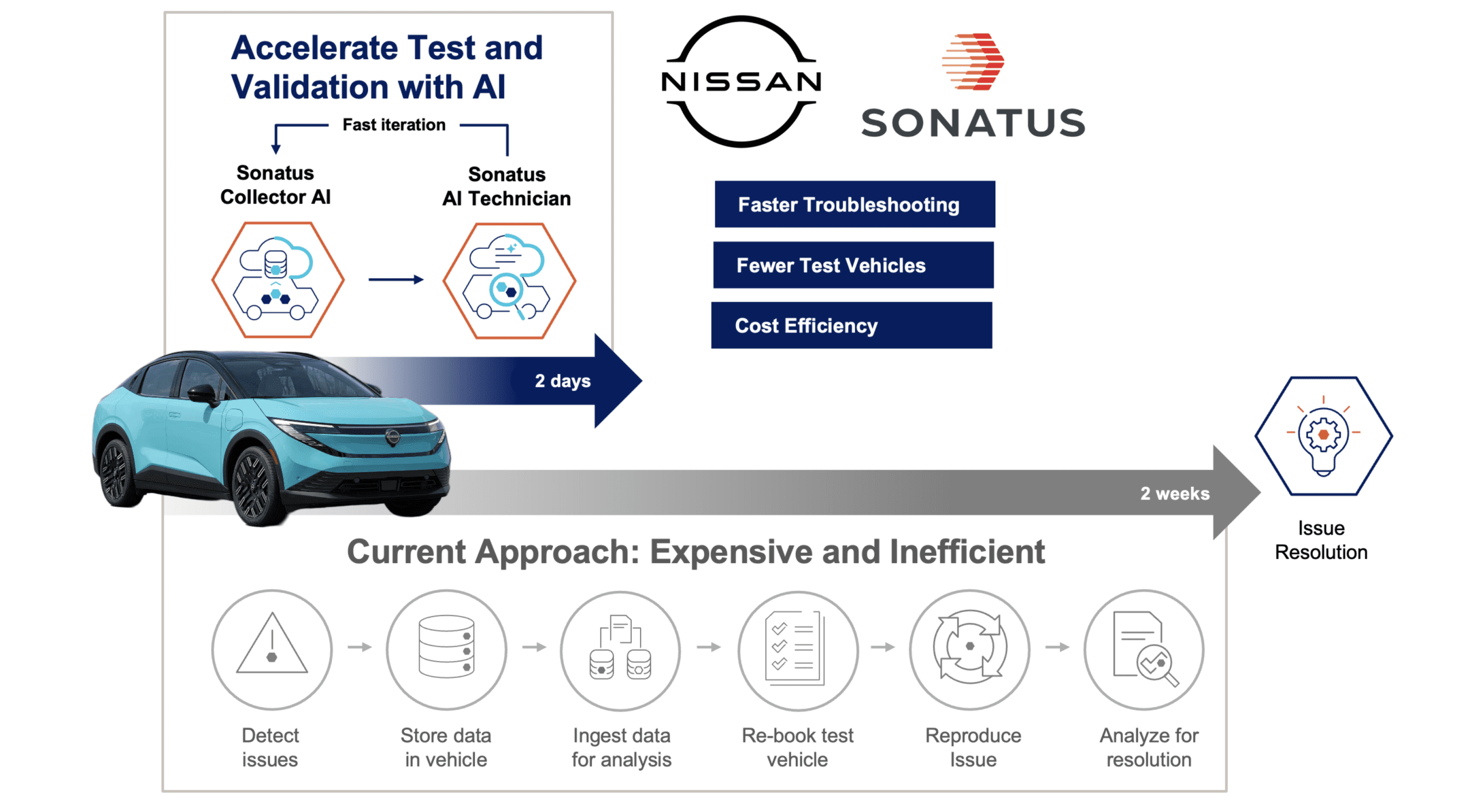
For decades, vehicle development has been a painstakingly slow process. Engineers would spend weeks, sometimes months, troubleshooting issues with physical test vehicles, burning through resources and delaying launches. But those days are rapidly becoming history. Thanks to artificial intelligence, what once took two weeks can now be accomplished in just two days.
At the heart of this transformation lies Sonatus’ cutting-edge AI toolkit, specifically their Collector AI and AI Technician platforms. These aren’t just fancy dashboards displaying data; they’re sophisticated systems that actively hunt for problems before they become catastrophic failures.
The technology works by harvesting vast amounts of information from vehicle sensors, electronic control units (ECUs), and onboard diagnostics tools. But here’s where it gets interesting: the AI doesn’t just collect data, it thinks. It automatically detects irregularities, potential failures, and operational inefficiencies that human engineers might miss or take weeks to identify.
Imagine having a tireless digital detective working 24/7, analyzing thousands of data points per second, spotting patterns that would escape even the most experienced automotive engineer. That’s exactly what Nissan’s engineers at their Cranfield, UK facility now have at their fingertips.
The early trial results are nothing short of spectacular. NTCE has demonstrated significant improvements in troubleshooting efficiency, dramatically reducing their reliance on physical test vehicles. The reduction in investigation time from two weeks to two days is transformative.
This acceleration fits perfectly into Nissan’s broader strategic vision. The partnership directly supports RE:Nissan, the company’s global recovery plan that emphasizes innovation through a digital-first approach. By leveraging simulation, advanced testing, and smart data analysis, Nissan is fundamentally reducing overall development time.
David Moss, Senior Vice President of Research and Development for Nissan’s AMIEO region, made a crucial point about the technology’s role: “The role of AI is clear, to act as a tool for our engineers and not a direct replacement”. This human-AI collaboration model is essential, the AI augments human expertise rather than replacing it, allowing engineers to investigate and act quickly while maintaining zero compromise on quality.
This isn’t experimental technology sitting in a lab somewhere. The AI tools are becoming a cornerstone of Nissan’s entire testing program, with immediate applications for highly anticipated future models including the all-new Nissan LEAF and the popular JUKE.
For Kiwi drivers eagerly awaiting these next-generation vehicles, this means something tangible: faster time-to-market without sacrificing the reliability and safety standards we’ve come to expect from Japanese engineering.
Alexandre Corjon, Senior Vice President and Technical Fellow for Sonatus, emphasized that this collaboration reflects “a shared commitment to an AI-driven future”. Founded in 2018, Sonatus has quickly established itself as a powerhouse in software-defined vehicle technology, with their solutions already deployed in over 6 million production vehicles from leading global automakers.
The company’s global footprint—spanning from their Sunnyvale, California headquarters to regional offices in Dublin, and locations across Bangalore, Detroit, Frankfurt, Kraków, Paris, Seoul, Shanghai, Taipei, and Tokyo—demonstrates the truly international nature of modern automotive innovation.
Tarmac Takeaway
This partnership represents a fundamental reimagining of how vehicles are developed. By enabling smarter data collection and accelerating digital development workflows, the collaboration sets a new benchmark for automotive innovation.
The implications extend beyond Nissan. As the automotive sector faces unprecedented pressure to accelerate electrification, improve sustainability, and meet evolving consumer expectations, AI-driven development processes could become the industry standard rather than the exception.