If you thought tyres could only roll and bounce, think again; they’re now spearheading a green revolution in Aotearoa New Zealand, complete with industry applause, compelling results, and a distinct absence of roadside dumps. Enter Tyrewise, the country’s first regulated tyre recycling scheme, which has brought rubber recycling closer to circularity—and managed to exceed early expectations with gusto.
With its launch in late 2024, Tyrewise has rapidly blazed a trail, collecting some 21,100 tonnes of end-of-life tyres in its first four months—a figure so impressive it left the original target of 8,000 tonnes eating its dust. What’s even more stunning is where all those tonnes went. Over 7,700 tonnes have already been repurposed for tyre-derived fuel and other innovative uses, while 7,000 tonnes have found their way into new manufacturing ventures. In comparison, the initial goal of 5,000 tonnes per category looks like a distant speck on the sustainability highway. It’s safe to say Tyrewise astonishes with every metric.
But what’s the secret sauce behind this rubber revolution? First, let’s talk money—or in this case, stewardship fees. A nifty “Tyre Stewardship Fee” is charged on all new tyres sold in New Zealand, funding the nationwide collection and recycling effort. This clever mechanism ropes in retailers, wholesalers, and transport operators spanning the country. Over 5,300 users have plugged into the Tyrewise collection app, a multi-stakeholder bonanza that includes tyre fitters, car dealers, fleet operators, and even scrap vehicle handlers. Think of it as Tinder for tyres: seamless matches between spare tyres and recycling services, with results that are far from trashy.
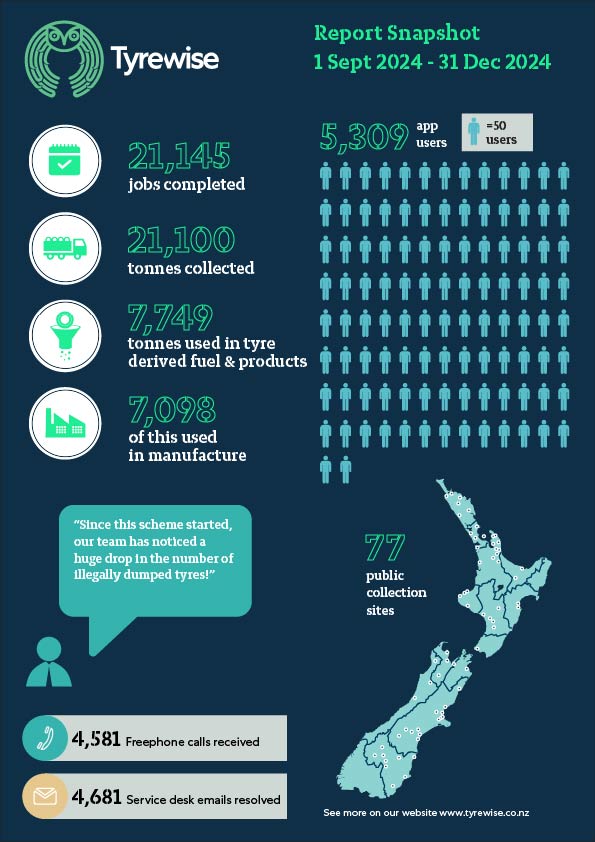
Speaking of trash—or more accurately, the absence of it—there’s been a tangible environmental impact. Palmerston North City Council has already reported a “huge drop” in illegally dumped tyres, clearly marking Tyrewise as an antidote to the scourge of rogue rubber littering the landscape. Meanwhile, 77 free public collection sites allow everyday citizens to dispose of five tyres at a time, ensuring rubber recycling isn’t just an industry endeavor but also a public responsibility.
Of course, nothing runs like a well-oiled machine without vision, and that’s where Tyrewise executives shine brightest. Chief Executive Adele Rose isn’t just satisfied with early success—she’s plotting an ambitious future. The scheme’s ultimate goal? By its fourth year, 80% of collected tyres will be processed domestically, with rubber entering vibrant local markets instead of wasting away overseas. To do this, the team plans to craft a robust “Market Growth and Investment Strategy” that will expand domestic rubber use into the farthest corners of New Zealand’s economy. This isn’t just about doing better; it’s about redefining the business of better.
From shifting old piles of rubber to promising new possibilities, Tyrewise is proving that innovation and industry-led stewardship can unite to address complex waste problems—and do so with flair. If you ever said a tyre’s life ends once it’s worn thin, Tyrewise is here to firmly reinvent that narrative. And judging by its rip-roaring start, this is one track they’re fully ready to dominate, speed bumps and all.