The New Zealand Government is moving to sharply reduce the fees associated with its Clean Vehicle Standard, in a step it argues is essential to prevent imported car prices from ballooning out of control. Transport Minister Chris Bishop says the changes will help protect consumers from steep cost increases, especially at a time when many are already feeling the pinch of financial strain.
Starting from the 1st January 2026, the charges applied to importers under the CVS will drop by almost 80 percent – yep, not a typo. For brand-new vehicles, the rate will decrease from a top tier of $67.50 per gram of CO₂ that goes over the ever decreasing threshold to just $15. For used imports, the highest rate will fall from $33.75 to $7.50. These reduced rates will apply throughout 2026 and 2027, and are related to the Fleet Average figures rather than the PAYG scheme (which interests me almost as much).

Bishop frames the move as a way to ease the financial burden on both importers and buyers. He argues that, without reform, the Clean Vehicle Standard wasn’t fit for its initial purpose anymore and could have driven up car prices by hundreds, or even thousands, of dollars for prospective owners, especially with EVs struggling to find as many buyers as initially thought.
This is because the CVS was originally designed to nudge importers toward cleaner, lower-emission vehicles by enforcing annual CO₂ emissions targets. But market conditions have shifted, and according to Bishop, many importers are now struggling to meet these targets. The majority of them reportedly face net charges rather than net credits.

On top of that, the supply of low-emissions used vehicles has tightened, while demand for new electric vehicles has cooled, and the constant revisions to the threshold mean that cars that were credit generators just years ago, now could even accrue a fee.
Although the reduced fees have been pitched as broad relief, the biggest savings will fall on higher-emission models. Some examples can be seen below, from a table provided by the Beehive:
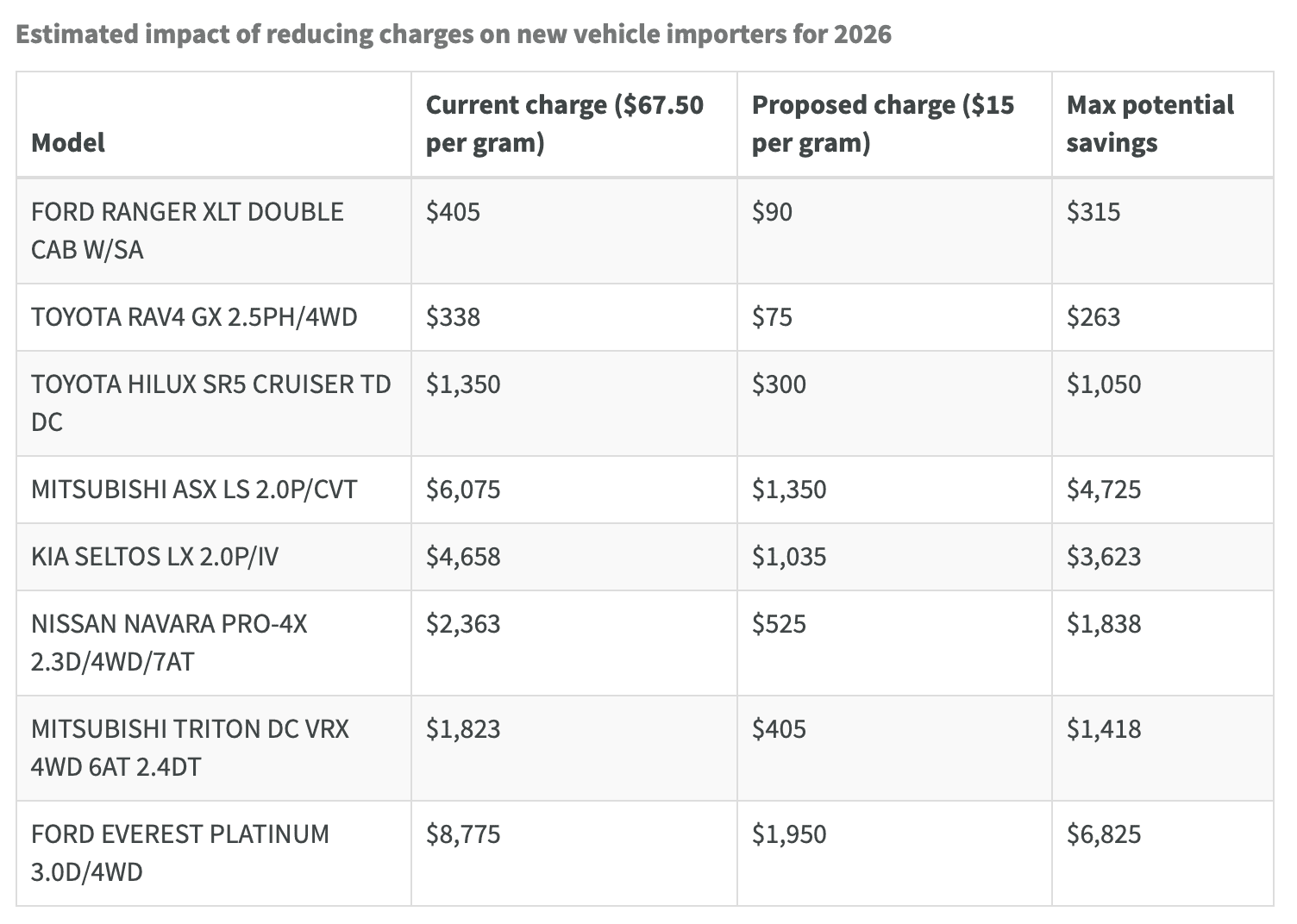
Of course, this “relief” does not mean a 1:1 discount on the MSRP, the same way the fees were not an increase. Bishop notes that the final price reductions for buyers will depend on how much of the fee-cut the importers choose to pass on, and how they structure their pricing, but it is likely the biggest savings will fall on higher-emission models
The Government projects that these fee changes will prevent $264 million in net charges that might otherwise have been passed on to consumers, with very little of this money actually finding its place here in NZ rather than overseas.
This comes as an amendment to the Land Transport (Clean Vehicle Standard) Amendment Bill (No 2), and should be incorporated into formal legislation.
A full review of the Clean Vehicle Standard is underway, and more changes could follow: the recommendations are expected to go to Cabinet by June 2026. To ensure stability amid the changes, the Government has committed to protecting existing credits under the CVS: their validity is extended until 31st December 2028.