
The aviation industry faces a tough challenge: how to reduce emissions when alternatives to fossil fuels are limited, especially on long-haul flights. Enter a groundbreaking Australian solution that’s about to take flight—quite literally.
The Big Picture: $32 Million in Clean Fuel Innovation
The Albanese Labor Government is backing an ambitious $92 million project with a $32 million investment through the Australian Renewable Energy Agency (ARENA) to transform forest waste into jet fuel. This is a strategic move to strengthen Australia’s fuel security and independence from volatile global energy markets.
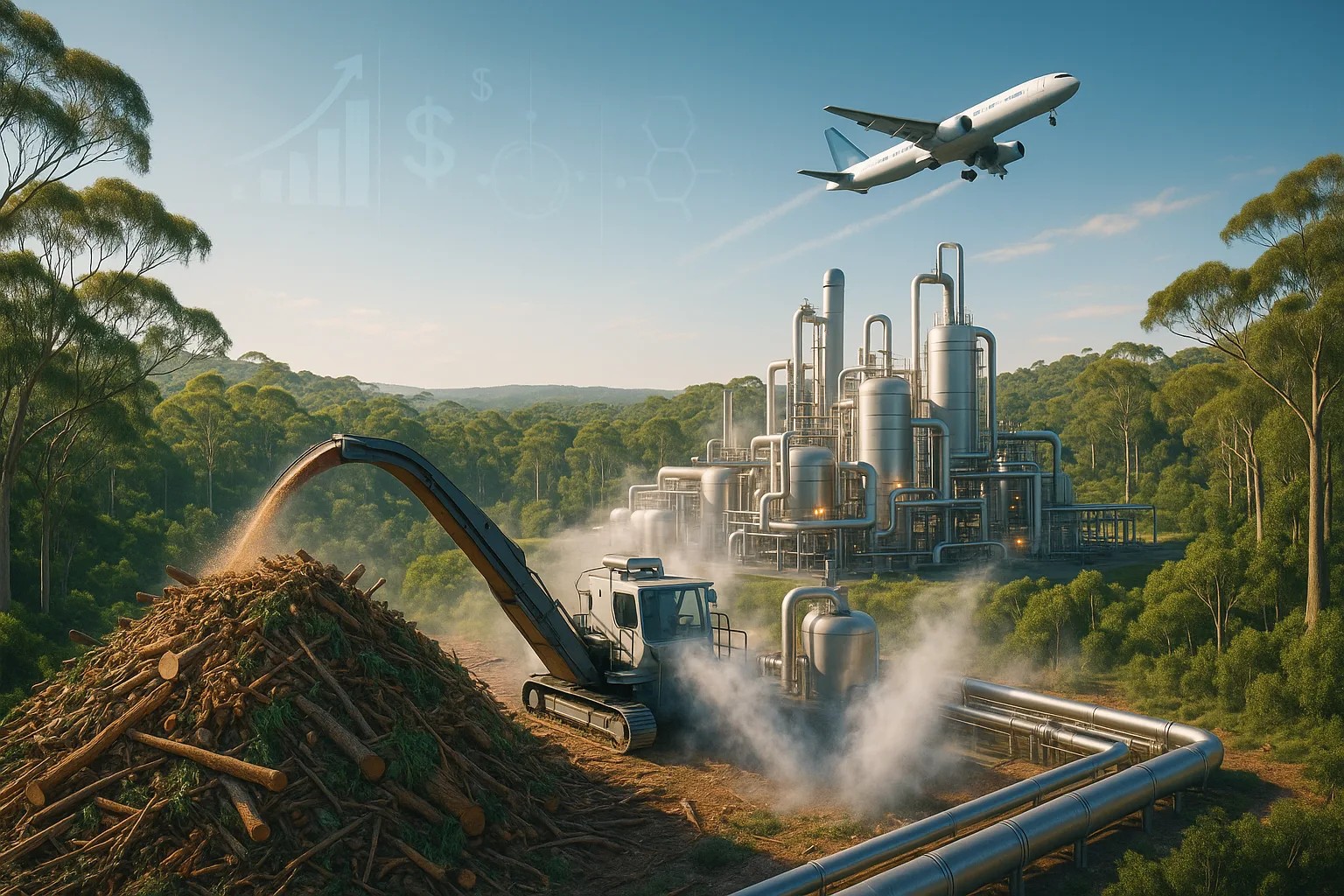
Here’s what makes this project particularly clever, it tackles two problems simultaneously. Australia generates enormous quantities of forest waste, the byproducts left behind after harvesting, including sawdust, bark, woodchips, and thinnings. Rather than letting this material rot or be disposed of, HAMR Energy’s project will convert it into something the world desperately needs: sustainable aviation fuel.
How It Works: Three Strategic Facilities
The project comprises three interconnected facilities working in perfect harmony :
Victoria’s Biomass Hub: A processing facility will handle approximately 600,000 tonnes annually of forestry residues, that’s roughly equivalent to processing waste from an entire region’s timber industry.
Portland’s Methanol Factory: The processed biomass gets converted into approximately 300,000 tonnes per year of renewable methanol, the crucial intermediate step that makes the whole operation possible.
Gillman’s Jet Fuel Conversion: The South Australian facility takes that methanol and transforms it into approximately 140 megalitres of sustainable aviation fuel each year. That’s enough to power thousands of long-haul flights annually.
Why This Matters for Australia
Liquid fuels account for roughly half of Australia’s national energy consumption. The shift toward sustainable alternatives represents a massive economic opportunity alongside genuine climate benefits. Sustainable aviation fuel is particularly important because it offers one of the few viable pathways to reducing aviation emissions on long-haul routes where electric alternatives remain impractical.
Beyond the environment, this project promises tangible economic benefits. It supports regional jobs across forestry, manufacturing, engineering, and aviation sectors. For plantation owners, it generates additional revenue streams from materials that previously had limited market value. For Australia, it builds fuel resilience and reduces vulnerability to international energy shocks.
The Industrial Advantage
Australia isn’t just joining the sustainable fuels race, it’s positioning itself as a leader. The country possesses abundant forest resources, proven engineering expertise, and innovative companies like HAMR Energy ready to scale solutions . This project represents the kind of sovereign fuel production that builds national resilience while capturing the economic benefits of the energy transition locally rather than shipping jobs and profits overseas .
Minister Catherine King’s statement captures the significance perfectly: this investment transforms waste into valuable fuel while bringing together industry partners and investors with world-class Australian expertise.
What’s Next?
ARENA’s funding operates in two stages. The initial $12.5 million supports early Front End Engineering Design work, with a further $19.5 million available once HAMR Energy secures necessary co-funding for detailed design phases. This staged approach allows for rigorous planning while maintaining momentum toward commercialisation.
Tarmac Takeaway
This $32 million investment represents more than a single project, it’s the foundation for an entirely new Australian industry. It demonstrates how environmental responsibility and economic opportunity can align perfectly. By converting waste into fuel, supporting regional communities, strengthening national energy security, and reducing aviation emissions, Australia is genuinely taking flight toward a sustainable future.