The Premium Contender in the Seven-Seat SUV Market

In an increasingly crowded SUV landscape, Mazda’s all-new CX-80 PHEV enters the scene with bold aspirations and a distinctive approach to the seven-seater formula. As the Japanese manufacturer’s new flagship model, the CX-80 aims to deliver a compelling blend of practicality, luxury, and driving dynamics while embracing hybrid technology. But does it truly offer the best of all worlds?

The CX-80 makes an undeniable statement from the outset. This stretched version of the CX-60 adds 250mm to the wheelbase (so the same platform as the CX-90), accommodating that crucial third row of seats. The result is a vehicle with genuine road presence that maintains Mazda’s reputation for elegant design.

While the front end carries over the CX-60’s sleek styling, the rear is somewhat less graceful. However, Mazda’s exceptional paint options elevate the overall aesthetic, providing welcome alternatives to the usual grayscale palette dominating the segment.

Step inside, and the CX-80’s premium aspirations become immediately apparent. Even in mid-level Homura trim, the materials and build quality impress, with higher specifications offering maple wood trim and white Nappa leather for those seeking additional luxury.
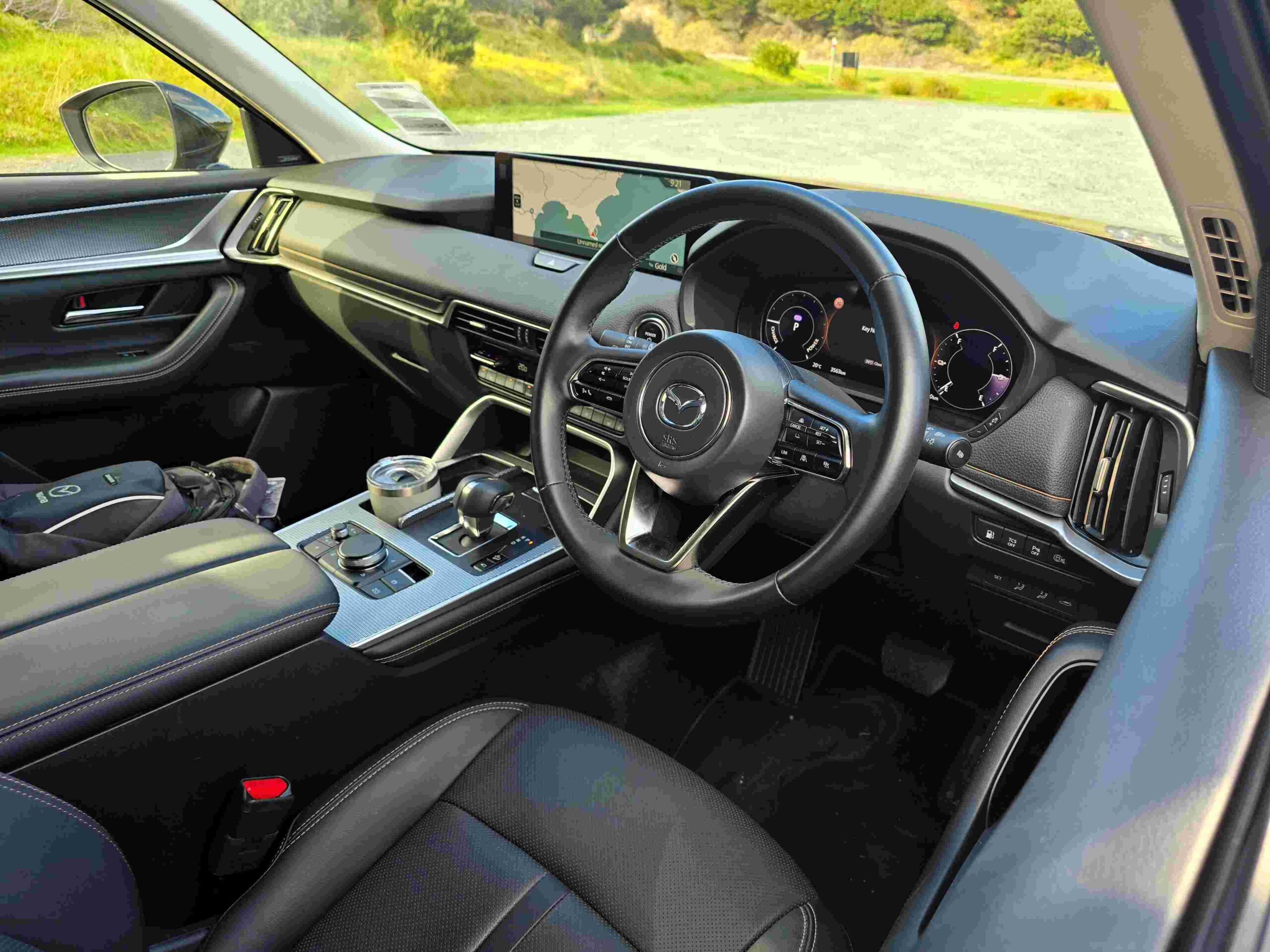
Mazda has wisely resisted the trend toward overwhelming touchscreen interfaces. Instead, the CX-80 features a refreshingly traditional approach with physical climate controls and a 12.3-inch infotainment screen operated via a rotary controller when driving. This setup minimises distractions, though Android Auto users might find themselves occasionally reaching for touchscreen controls that require the dial instead.

Space is undoubtedly one of the CX-80’s strongest selling points. With its 3,120mm wheelbase (just 77mm shy of the long-wheelbase Range Rover), the middle row offers genuine roominess. The third row is serviceable though not class-leading. Mazda claims it can accommodate passengers up to 170cm tall, but it’s still best suited for children or flexible adults on shorter journeys. Accessing these seats is straightforward thanks to a one-button mechanism that doesn’t require excessive strength.
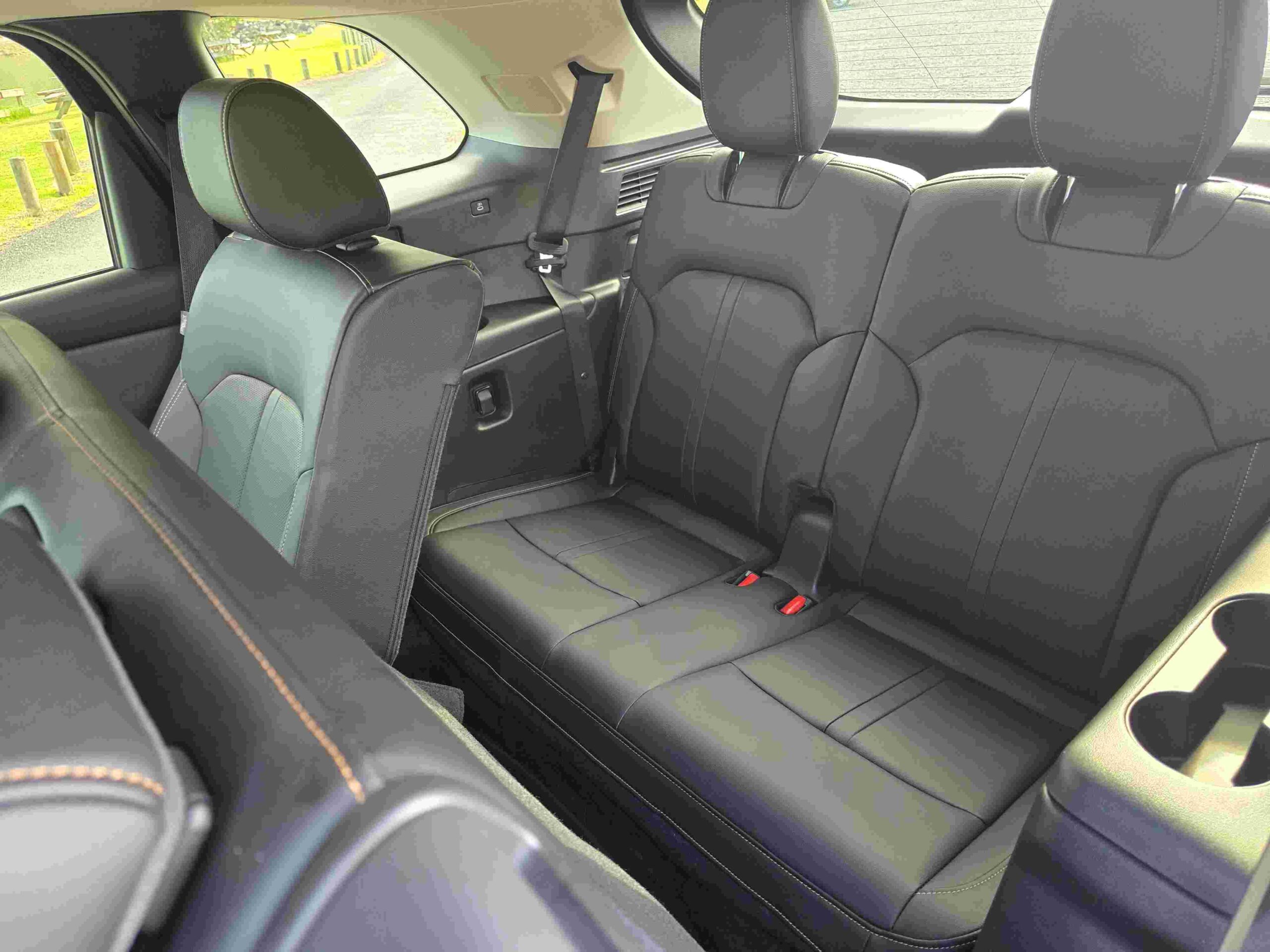
Cargo capacity is respectable but again not class-leading: 258 litres with all seats up and 687 litres in five-seat configuration. By comparison, the Skoda Kodiaq offers 845 litres in five-seat mode.

Then there’s what drives it. The CX-80 PHEV combines a 2.5-litre petrol engine with an electric motor, delivering impressive combined outputs of 241kW and 500Nm of torque. This translates to sprightly performance for such a large vehicle, with 0-100kph dispatched in around 6.8 seconds.

With a fully charged 17.8kWh battery, the CX-80 can cover approximately 50km in electric mode, making short commutes potentially fuel-free. The transition between electric and petrol power is generally smooth when under gentle acceleration, with the engine starting up with minimal fuss.

However, once the battery depletes, the driving experience deteriorates somewhat. The 2.5-litre engine, while relatively quiet, sounds strained when pushed, and the powertrain’s refinement noticeably decreases. Fuel economy in this state is around 10.2km/L, reasonable considering the vehicle’s 2,267kg mass but not particularly impressive compared to hybrid-only alternatives from Hyundai and Kia.
For those frequently taking longer journeys without regular charging access, it’s worth noting that the CX-80 also offers a 3.3-litre straight-six diesel engine option, which may prove more efficient.

More importantly, how does it drive. Well, the CX-80 features softer springs, revised bushings, and a reworked rear axle setup as compared to the CX-60. The result is certainly an improvement. Where the CX-80 genuinely shines is in its handling characteristics. True to Mazda’s reputation for driver engagement and aided by its clever torque vectoring and KPC (Kinematic Posture Control), the CX-80 offers well-weighted, accurate steering and controlled body movements despite its considerable size and weight. It feels remarkably stable at highway speeds and surprisingly manageable around town, helped by excellent visibility, narrower stance (than the CX-90) and a very clear 360-degree camera system.

The Mazda CX-80 PHEV certainly makes a compelling case as a premium seven-seater with distinctive styling, a quality interior, and engaging driving dynamics. It offers genuine space for large families and, with regular charging, can deliver economical short-distance commuting.

For families who can regularly charge the vehicle and value Mazda’s approach to design, materials, and driving dynamics, the CX-80 PHEV represents an appealing package that successfully bridges the gap between mainstream and luxury seven-seat SUVs. It may not be perfect in every aspect, but it offers a distinctively Mazda take on the premium family hauler, one that prioritises driver engagement alongside practical family considerations.