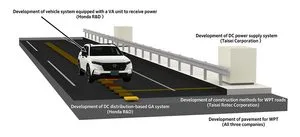
Honda has teamed up with Taisei Corporation and Taisei Rotec Corporation to develop the core technology behind a road system that would let electric vehicles charge wirelessly while driving, rather than requiring a stop at a charging station. The companies describe it as a dynamic wireless power transfer (DWPT) system, built around magnetic coupling between the road and the vehicle.
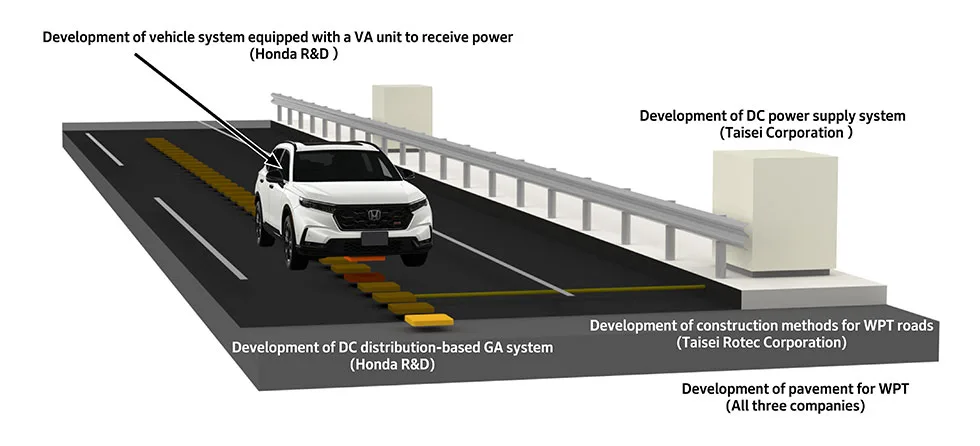
The system has three main parts: a ground-based DC power supply, DC-distribution ground assembly units embedded directly into the road surface, and a receiver unit mounted on the vehicle. In testing so far, the technology has supported vehicles weighing up to roughly 20 tons, large enough to cover commercial trucks, and the partners are targeting power output of up to 150 kW in future versions. The embedded road units have been put through durability testing equivalent to one million wheel passes, aimed at proving the system can hold up under sustained traffic loads rather than just short-term trials.
Development work began in 2025, with construction of a dedicated test roadway planned for late 2026 at Honda’s T-FIELD/SATTE and T-FIELD/TAMURA facilities. From there, the partners intend to move to public road demonstration testing starting in Japan’s 2027 fiscal year, on the Tateyama Expressway in Chiba. The technology is also being shown off at two industry events this month: the Japan Mobility Show Bizweek, and the ITS World Congress 2026 in Gangneung, South Korea.
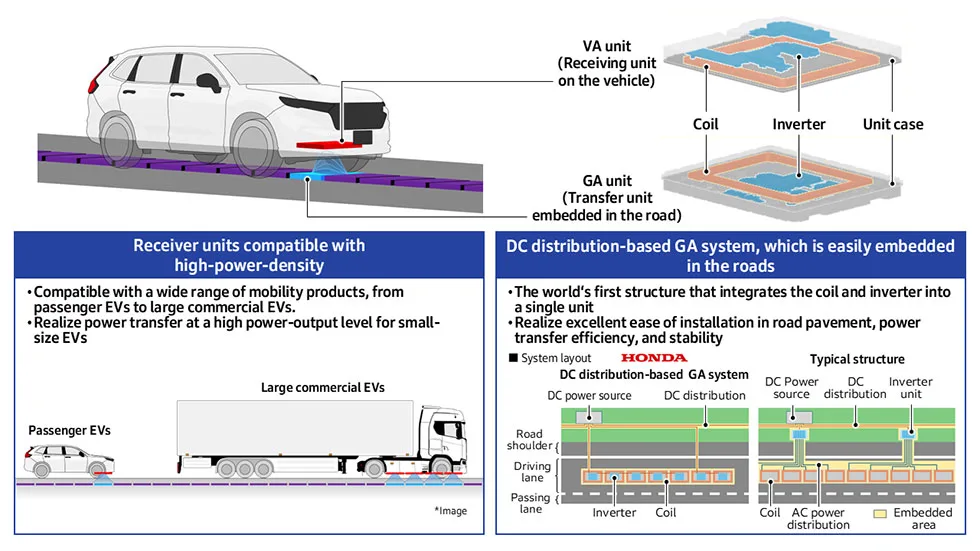
The companies frame the project as a way to make EV ownership more convenient by cutting down how often drivers need to stop and plug in, while also supporting Japan’s 2050 carbon-neutrality goals. Cost is definitely a hurdle now, both of embedding power infrastructure into roads and of fitting receiver hardware into vehicles, something the upcoming public road trials should start to clarify.