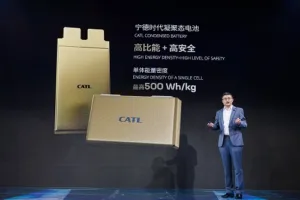
CATL has started trial production of 20 Ah all-solid-state cells, aiming for 500 Wh/kg and small-scale output in 2027, though mass production is still pencilled in for around 2030.
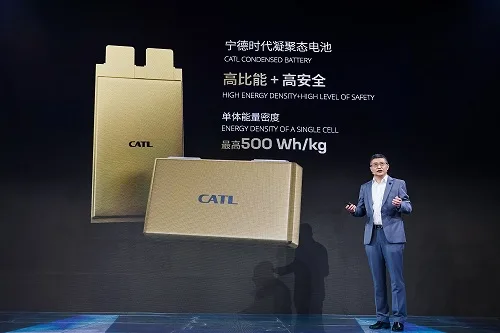
Solid-state batteries have been “a few years away” for about as long as anyone can remember. Now the world’s biggest battery maker has given that promise a firmer number. CATL says its sulfide-based all-solid-state cells have entered trial production at 20 Ah, with an energy density target of 500 Wh/kg.
The company confirmed the progress when investors asked about its solid-state programme on Tuesday. It still plans small-scale production in 2027, with output limited at first. Mass production is expected around 2030.
What CATL Has Actually Confirmed
Amp-hours measure how much charge a cell can hold, so moving to 20 Ah cells is a step towards practical sizes. The 500 Wh/kg figure is a target rather than a result CATL has announced. That distinction matters, because energy density decides how much range a battery pack of a given weight can deliver.
CATL is also frank about how far it has to go. Speaking at the Summer Davos Forum in June, chairman and CEO Robin Zeng put all-solid-state batteries at level four on a nine-point scale. That’s an honest self-assessment, and a useful brake on the hype.
Why Solid Electrolytes Are Hard
All-solid-state batteries carry lithium ions through a solid electrolyte rather than a liquid. Semi-solid-state designs, by contrast, still use some liquid. CATL’s sulfide-based system offers high ionic conductivity and can deform, both helpful traits.
However, keeping solid components in stable contact with one another remains a hurdle. Liquids naturally fill gaps. Solids don’t, and that is where much of the engineering effort goes.
A Crowded 2027 Start Line
CATL is far from alone in aiming for 2027. Several rivals have announced similar timelines:
- Toyota aims to launch its first all-solid-state EV in 2027 or 2028. It claims its prototype can deliver 1,200 km of range and charge in under 10 minutes, though production will be limited at first.
- Samsung SDI plans to start mass production of its SolidStack batteries in the second half of 2027.
- BYD intends to launch its first solid-state vehicle in 2027. Its FinDreams battery division plans limited batches of sulfide-based cells that year, ramping up to mass production by 2030.
Toyota has been promising solid-state batteries for nearly a decade, so we’d treat those range and charging claims as manufacturer figures until production cars prove them. BYD executive vice president Stella Li, meanwhile, says the company holds “the leading position” and will prove it next year. Bold talk from the number two, then.
CATL’s lead is substantial. SNE Research data gives it 39.9% of the global EV battery market in the first half of 2026.
Not the Only Chemistry in Play
Solid-state gets the headlines, but it isn’t the whole story. CATL, BYD and others are still developing lithium iron phosphate (LFP) and sodium-ion batteries, which target lower costs and different performance needs. BYD’s second-generation Blade LFP pack already delivers more than 1,000 km of range on the CLTC cycle.
That puts the solid-state race in perspective. Mass-market solid-state cells are still pencilled in for around 2030, and today’s LFP packs are already covering long distances. For buyers, the more useful near-term story may be the cheaper chemistries arriving well before the so-called holy grail does.