What if your next electric vehicle could do more than get you from A to B? What if it could keep the lights on during a blackout, help reduce your electricity bill, and even become part of the solution to an increasingly demanding power grid? Ford reckons the future is going both ways.
Electric vehicles have spent years trying to convince motorists that plugging in is the future. Now, Ford wants to give us another reason to embrace the cable: your EV could become a giant battery on wheels.
And no, we’re not talking about using your ute to charge your phone while camping. We’re talking about bidirectional charging, a technology that allows electricity to flow into an EV’s battery and back out again, potentially powering your home or helping balance demand on the electricity grid.
It’s a clever idea, but there’s been a catch. Until now, the cost and complexity of the additional equipment required have largely kept the technology out of reach for everyday buyers.
Ford reckons it has a solution, and its upcoming electric truck, the Ford Fathom, is set to be a key part of the plan.
Your Next EV Could Be Your Home’s Backup Generator
Let’s start with the basics. Most electric vehicles are essentially one-way streets when it comes to electricity. You plug them in, charge the battery, unplug them and drive away. Simple. Bidirectional power changes that equation by allowing energy to travel in both directions. Your vehicle can still charge as normal, but it can also send electricity back to an external system when required.
That opens up two particularly useful possibilities.
First, there’s vehicle-to-home (V2H) technology, which allows an EV to supply electricity to a house. During a power outage, that could mean keeping essential appliances running without relying on a conventional petrol or diesel generator.
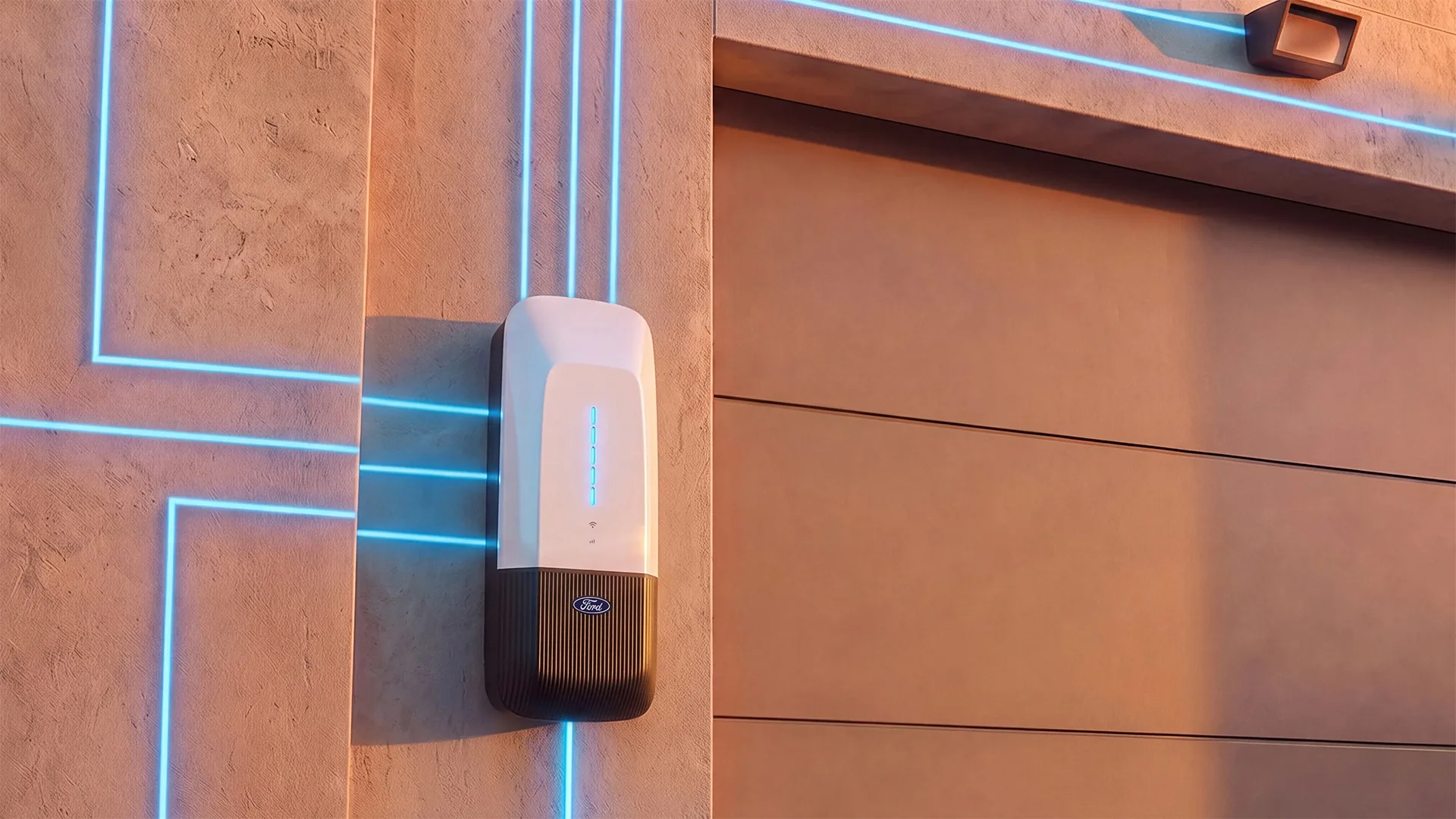
Second, there’s the potential to manage household electricity consumption more intelligently. Charge your vehicle when electricity prices are lower, then use the stored energy to power your home when prices rise.
The result? Potential savings on electricity bills, greater energy independence and a rather useful backup plan when the weather decides to throw a tantrum.
Of course, the actual benefits will depend on electricity tariffs, household consumption, the vehicle’s available battery capacity and the hardware required to make everything work. But the concept is compelling, your vehicle already spends a considerable amount of time parked. Why not put that battery to work when you’re not driving?
Ford Wants to Make the Technology More Affordable
One of the biggest obstacles to widespread bidirectional charging has been the cost of converting the electricity stored in an EV’s battery into the type of electricity used by homes.
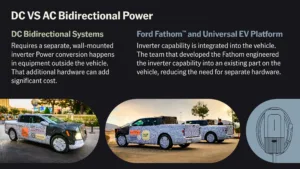
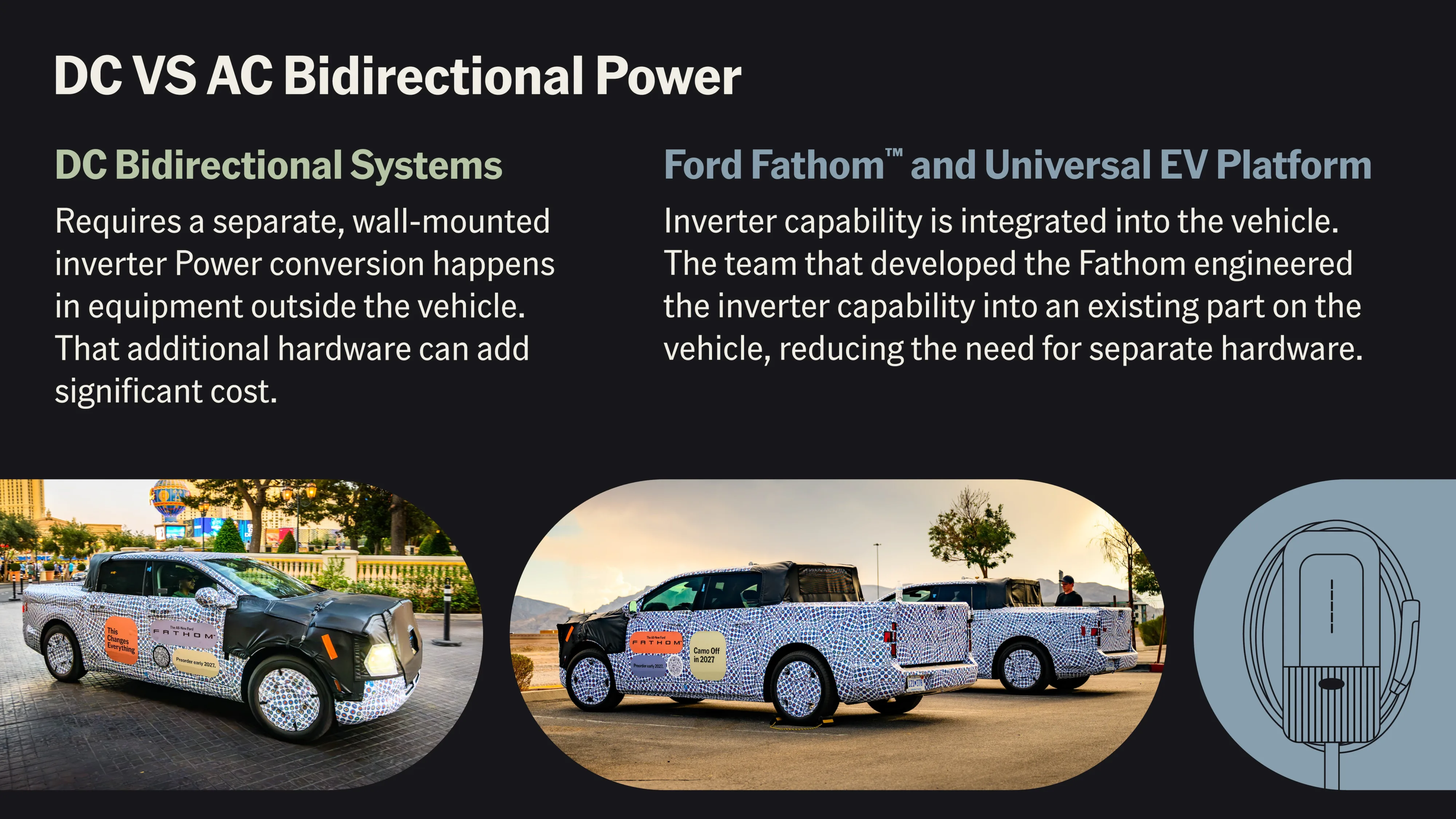
An EV battery stores direct current (DC), while household electrical systems use alternating current (AC). Converting between the two requires suitable power electronics, and traditionally, that has meant additional equipment installed outside the vehicle. That extra hardware adds expense, complexity and another potential headache for buyers.
Ford’s approach is to integrate more of the necessary technology directly into the vehicle. Following its acquisition of technology company Auto Motive Power in 2023, Ford developed a new bidirectional power system for its Universal EV Platform. The aim was not simply to add another feature to an electric vehicle, but to rethink the underlying hardware and reduce the cost of delivering it.
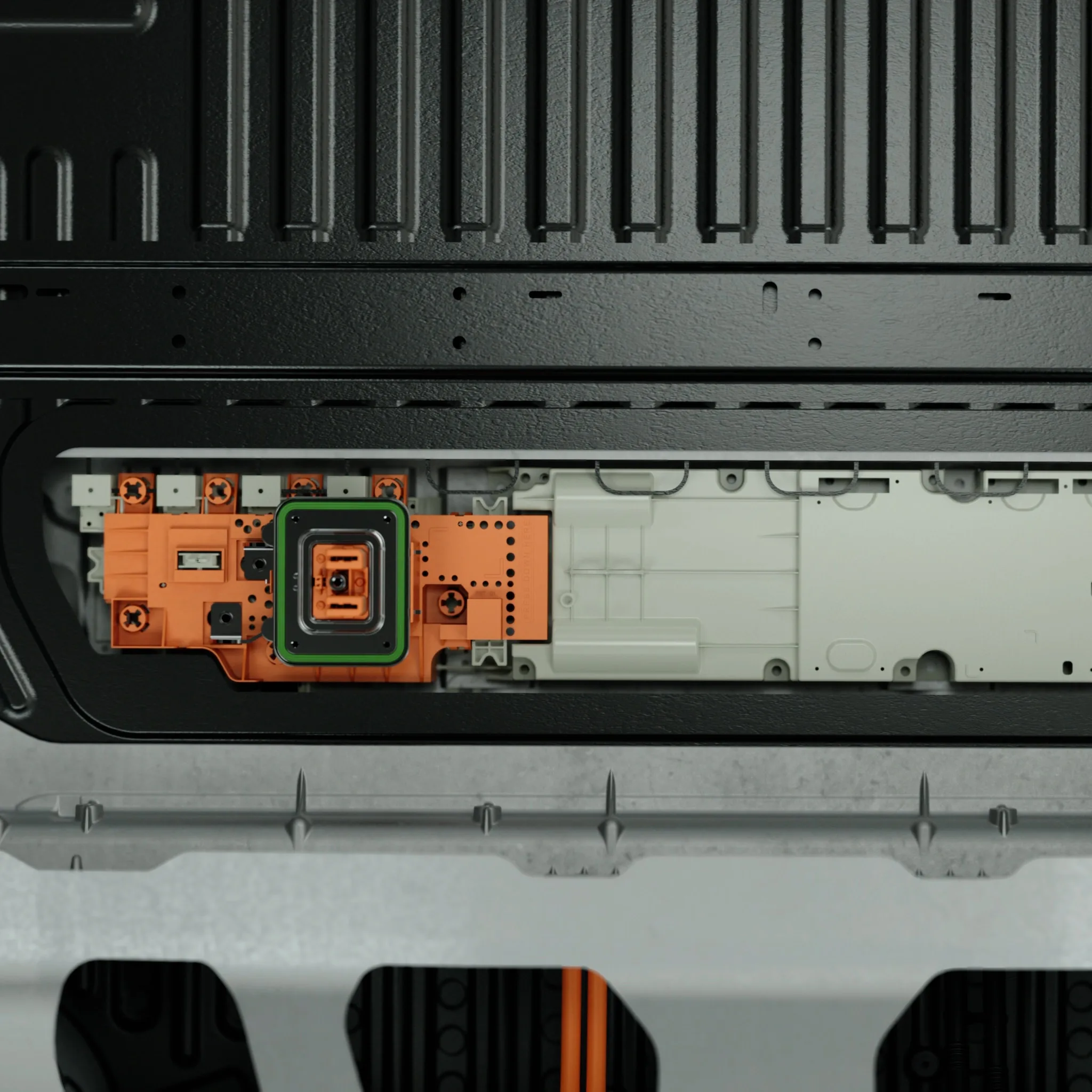
The system incorporates the inverter into the vehicle’s E-box, one of five major modules in the platform. By combining functions and reducing the number of separate components, Ford hopes to make bidirectional power more affordable and accessible to a much broader group of customers.
And that brings us to the Fathom.
Meet the Ford Fathom: An Electric Truck With a Bigger Job
Due to arrive in 2027, the all-new Ford Fathom is a midsize electric pickup designed around Ford’s Universal EV Platform. In the United States, Ford has announced a starting manufacturer’s suggested retail price of US$28,350 for the standard-range version.
More importantly for this story, the Fathom is designed to offer bidirectional AC power without requiring a separate, wall-mounted inverter to supply a home. Ford projects that the system will be capable of supplying more than 10kW of AC power to a house.
That’s a substantial amount of power for a vehicle-based system, although what you can run simultaneously will depend on the home’s electrical setup and the equipment installed.
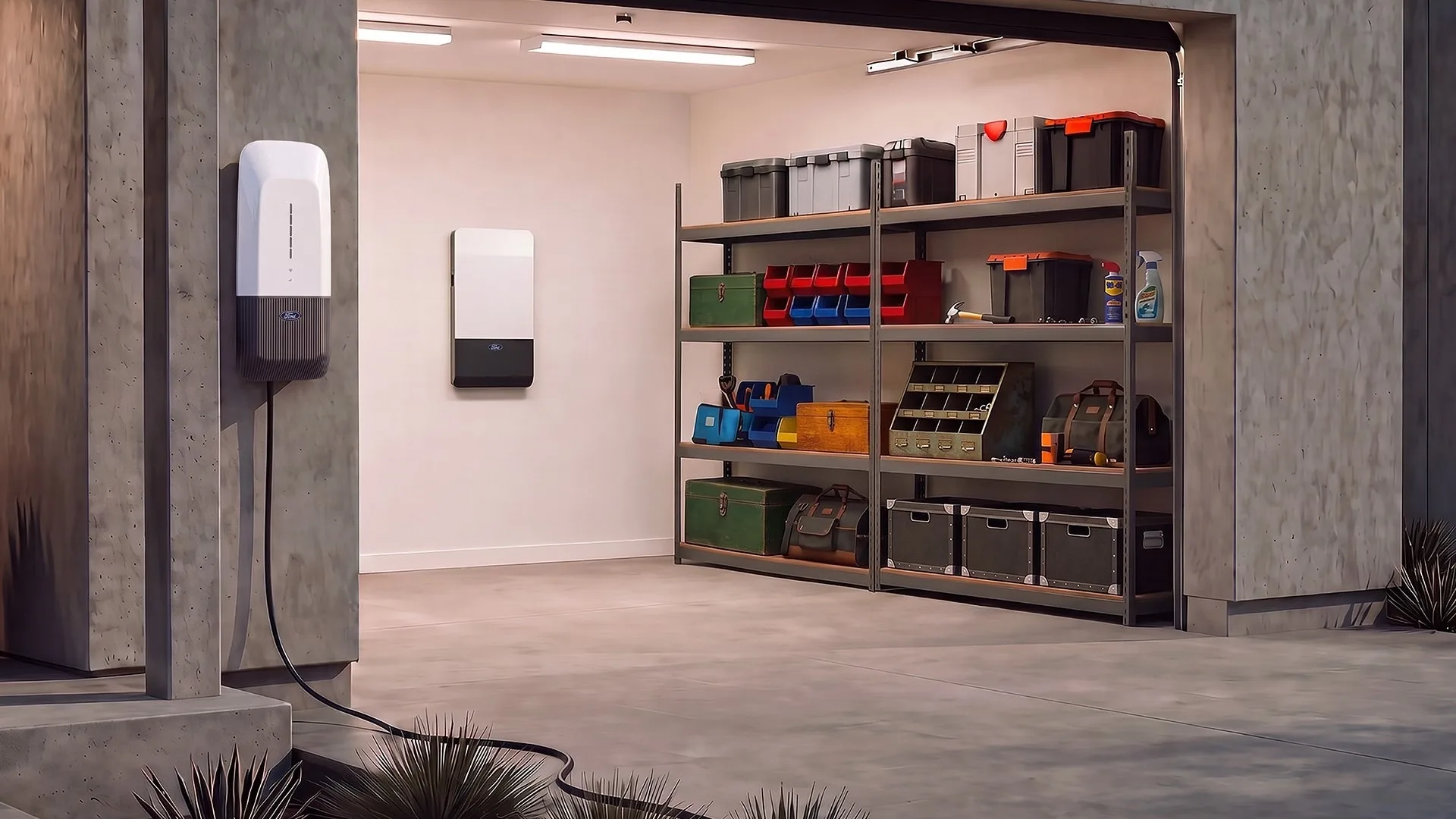
For comparison, this isn’t just about keeping a few LED lights glowing during an outage. Properly configured, a system of this capacity could potentially support a much wider range of household needs. Ford is also developing dedicated home equipment to make the technology practical.
Its Home Power Station is intended to support home energy management, while a Home Backup Power Panel will be required for the backup-power setup. According to Ford, the new Home Power Station is expected to cost around half as much as its first-generation bidirectional charging hardware, while the home backup equipment is expected to cost at least 60% less than its first-generation equivalent.
Those are promising reductions, although the final cost of a complete installation will still matter to buyers. After all, affordable technology isn’t quite so affordable if the installation bill arrives looking like the invoice for a luxury European SUV.
There’s More to It Than Plugging In
Of course, developing a clever charging system is only half the battle. Connecting a vehicle to a home’s electrical system requires appropriate hardware, safeguards and approvals. Sending electricity back into the wider grid introduces another layer of complexity.
Electricity networks have traditionally been designed around power flowing from generators through the grid to consumers. Rooftop solar and stationary battery systems have already challenged that arrangement by allowing homes and businesses to send electricity back into the network.
Bidirectional EVs introduce a new variable: the battery isn’t sitting permanently in one location. It’s a vehicle. It moves. That distinction matters when utilities and regulators decide how these systems should connect to the grid, what safety requirements apply and how they should be managed.
Ford points out that more than 3,000 utilities operate across the United States and Canada, many with their own interconnection processes. In other words, developing a system that works technically is one thing. Getting it approved and integrated consistently across thousands of different utility networks is another.
To tackle the issue, Ford established a utility working group in July 2026, bringing together five major energy providers: American Electric Power, BC Hydro, Consumers Energy, Exelon and Pacific Gas and Electric Company.
The objective is to develop scalable processes before the Fathom reaches customers in meaningful numbers.
Three Principles for Getting the Grid Ready
The working group has identified three priorities.
1. Recognise that EVs are different
Electric vehicles shouldn’t automatically be treated like permanent installations such as rooftop solar panels or stationary battery storage.
Ford argues that customers using an EV simply for charging, or for isolated backup power, shouldn’t face the same grid-interconnection requirements as customers exporting electricity into the network.
The distinction is important. Using a vehicle to power your home during an outage is not necessarily the same as operating it as an active participant in the electricity grid.
2. Prepare for changing technology
Standards and regulations need to keep pace with bidirectional charging systems, including technologies that use both AC and DC architectures. Clear, consistent requirements should help manufacturers develop compatible systems and make it easier for customers to adopt the technology.
3. Work together
Automakers, utilities and regulators need to collaborate rather than develop separate solutions that may not work well together. Ford and its utility partners intend to continue working on education, regulatory processes and practical implementation.
It’s hardly the glamorous side of automotive innovation, but it could prove just as important as the engineering inside the vehicle. After all, there’s little point having a truck capable of powering your home if the paperwork required to connect it becomes a project of its own.
Could This Work in New Zealand?
New Zealand has its own energy challenges, from winter electricity demand and changing wholesale prices to the resilience of power supplies during severe weather. An EV that can supply a home during an outage could be particularly appealing to households wanting another layer of energy security. And with more electric vehicles appearing on our roads, the potential for using their batteries beyond transportation deserves serious consideration.
However, Ford’s announcement is focused on the North American market, and its plans shouldn’t be mistaken for confirmation that the Fathom or its complete bidirectional charging system will be available in New Zealand.
Local availability would depend on several factors, including vehicle supply, compatible charging equipment, electrical installation requirements, applicable standards and approval for any grid-export functionality.
The economics would also need to stack up. The cost of the vehicle, installation, electricity tariffs and the amount of energy a household uses would all influence whether the system could deliver meaningful savings.
Nevertheless, the broader idea is relevant here. As renewable electricity generation expands and energy demand changes, using existing EV batteries more intelligently could become an increasingly valuable part of the equation.
Rather than building more stationary storage for every possible need, energy providers may eventually be able to draw on a network of vehicles that are already sitting in driveways and car parks.
That doesn’t mean every parked EV will automatically become a miniature power station. Owners would need compatible hardware, appropriate agreements and enough battery charge to meet their own driving needs. But the possibilities are worth exploring.
The Bigger Picture: Your Car as Part of the Energy Network
Ford’s bidirectional power strategy is about more than adding another gadget to an electric pickup. It’s an attempt to make the battery in an EV more useful, potentially helping owners manage household energy costs while providing backup power and creating opportunities for utilities to improve grid resilience.
There is also a wider concept at play: virtual power plants. These systems can coordinate multiple distributed energy resources, such as household batteries, solar installations and compatible electric vehicles, to help respond to electricity demand.
If bidirectional EV technology becomes affordable and straightforward to connect, vehicles could eventually contribute to these networks when parked and available.
That future will require more than clever engineering. It will depend on customer participation, compatible technology, sensible regulations and a financial incentive for owners to make their batteries available.
Ford’s work with utilities suggests the company understands that challenge. And by integrating the necessary power electronics into the vehicle itself, it is trying to tackle one of the biggest barriers before the technology reaches a larger audience.
Tarmac Takeaway
Electric vehicles have already challenged our ideas about what a car or truck should be. They’ve brought instant torque, quiet running and new approaches to vehicle ownership. Now, Ford wants to add another role to the job description: household energy storage.
The upcoming Fathom is expected to bring bidirectional power to a more affordable segment of the US EV market, while Ford works with utilities to make connecting these vehicles to the wider energy system easier.
Whether it will transform the way we power our homes remains to be seen. The technology still needs to prove itself in the real world, and affordability, compatibility and regulation will determine how widely it spreads.
But the underlying idea makes a lot of sense. If you’re going to park a large battery in your driveway every night, why should it only have one job? The future of electric motoring might not just be about how far your vehicle can travel on a charge. It could also be about what that battery can do when the driving is done. And that, surely, is a more interesting proposition than simply arguing about how long it takes to charge.