From electric super-cars and adventure-ready SUVs to commercial vans, battery upgrades and cars that could one day power your home, New Zealand’s first EV & Tech Expo had plenty to plug into. And there’s one thing that became abundantly clear – the EV conversation has changed.
Let’s be honest, there was a time when mentioning electric vehicles at a Kiwi BBQ was likely to produce one of three responses: a lecture about coal-fired electricity, a question about towing, or someone confidently declaring that EVs would never catch on. Fast forward to 2026 and, well, things look rather different.
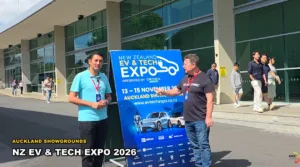
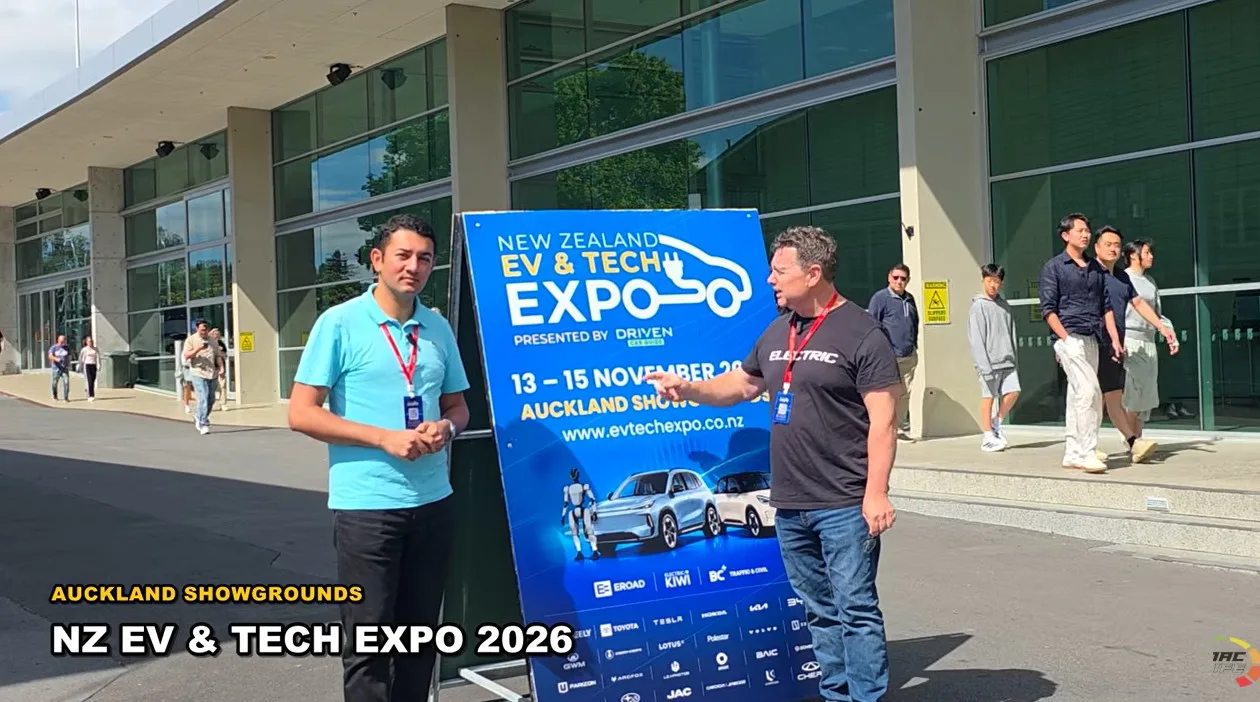
The inaugural New Zealand EV & Tech Expo brought together a sizeable collection of automotive manufacturers, importers, technology providers and curious consumers. And if the crowds, test drives and sheer variety of vehicles were anything to go by, the electric revolution isn’t exactly struggling to get out of first gear (do EV’s even have gears?).
But perhaps the most interesting thing wasn’t the cars themselves. It was the questions people were asking. Rather than the familiar “How far will it go?” and “Where will I charge it?”, the conversation has moved towards something much more practical: “Will it work for me?” That’s a significant shift.
Kia – Electrifying The Mainstream
One of the biggest manufacturer presences belonged to Kia, with national sales manager Justin Benzie explaining that the expo offered an opportunity to showcase the brand’s growing electrified line-up. Kia has been steadily expanding its EV and hybrid offerings, and Benzy described the event as its biggest vehicle exhibition in New Zealand to date.
The stand was certainly substantial, with a broad range of vehicles designed to appeal to different buyers and different stages of electrification. And there’s more to come, particularly with the Kia PV5 and further developments expected next year.
The message? Kia isn’t simply dipping its toes into the electric pool – it’s preparing to make a considerably bigger splash.
Subaru – Adventure Doesn’t Have To Mean Petrol
Subaru and electrification might once have seemed an unlikely pairing. After all, the brand has built much of its reputation around symmetrical all-wheel drive, adventure and the occasional muddy excursion. However, its electric future is beginning to take shape with the Trailseeker and Uncharted.
We caught up with Will from Subaru, who was understandably enthusiastic about the response to both vehicles. Despite their different footprints, the two share a similar driving character, with all-wheel-drive capability, fully electric powertrains and the ability to venture beyond the smooth stuff. Importantly, Subaru isn’t abandoning its adventure DNA. It’s simply finding a different way to power it.
Farizon – Electric Vans Make Business Sense
One of the more interesting conversations came from Farizon, where the V7E commercial van was demonstrating that EVs aren’t just about saving money on the school run. With a claimed range of 329km, the V7E is aimed squarely at businesses looking to reduce operating costs.
And there’s a particularly interesting development here: Farizon has already delivered 50 vehicles to NZ Post and its delivery partners. According to the Farizon brand manager Kevin Richards, the arrival of price parity with diesel-powered vans is encouraging more businesses to investigate electrification.
With diesel costs continuing to put pressure on operating budgets, the potential savings become increasingly attractive. There’s also the convenience factor. Charge at your depot or at home, start the day with a full battery and forget about scheduling a trip to the fuel station. For businesses running predictable delivery routes, that could be a rather compelling proposition.
Polestar – Luxury, Performance And A Massage
If the Farizon was all about business, Polestar was happy to demonstrate that electric motoring can be rather indulgent.
We caught up with Bruce Fowler from Polestar/Nordeast inside the recently arrived Polestar 5, a vehicle that represents the brand’s latest flagship ambitions. With five years of development behind it, the Polestar 5 was undoubtedly one of the event’s headline attractions.
But it wasn’t just sitting pretty. Polestar had 12 vehicles available for test drives and had completed 61 drives the previous day, with plenty more happening during our visit. In fact, at one point, 10 vehicles were out on the road simultaneously.
And while discussing the car’s impressive technology, we discovered that someone had helpfully activated both the heated seats and massage function. The massage was welcome. The increasingly enthusiastic heated seat was perhaps a little less so!
ADHL – Something Electric For Everyone
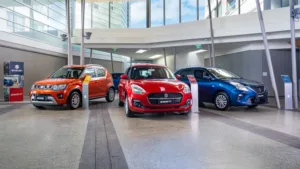
The Auto Distribution Holdings stand brought together an eclectic collection of brands, including Smart, Dongfeng, Forthing and Arcfox. It was a useful demonstration of just how broad the EV market has become.
From compact city cars to larger family vehicles and performance-oriented offerings, there are now plenty of different ways to go electric.
Arek from ADHL made an interesting observation about the changing mindset of prospective buyers. A few years ago, people were asking what an EV actually was. Then came the inevitable range anxiety questions. Now, the questions are much more lifestyle-oriented.
Will it fit the kids? Is it big enough? Is it fast enough? Does it suit my daily commute?
In other words, EVs are increasingly being judged like any other vehicle – on whether they’re actually right for the person buying them. And that’s exactly where the market needs to be.
Honda – Super One, Super Cute And More
Honda’s stand was attracting plenty of attention, largely thanks to the rather adorable Super One. Finished in its distinctive purple Kuro Edition treatment, complete with a two-tone finish and extended spoiler, this little EV was certainly turning heads.
Honda’s Safi Rizwan explained that it was currently the brand’s only fully electric passenger vehicle in New Zealand, and the response from visitors had been extremely encouraging.
But Honda had another trick up its sleeve. Alongside the Super One was its electric Motocompacto-style mobility offering, a compact electric scooter designed to fit into the car. However, Honda was quick to point out that this particular product wasn’t currently available for sale in New Zealand.
There was more to the stand than cars and scooters, too. Honda was showcasing its battery-powered outdoor equipment, including lawnmowers, edge trimmers and chainsaws. It’s a reminder that electrification isn’t confined to the driveway. It can extend right around the home.
BYD – From Unknown To Unmissable
Perhaps the most telling conversation of the expo came from BYD. Warren from BYD New Zealand reflected on the brand’s arrival in 2022, when it was still relatively unknown to Kiwi motorists. Fast forward four years and the brand has become one of the most significant players in New Zealand’s electrified vehicle market. And it’s not slowing down.
BYD currently has 19 different vehicle variants available, with another 10 to 15 models potentially arriving next year. However, Warren was keen to point out that New Zealand is a relatively small market, meaning new models need to make commercial sense, be relevant to local buyers and be properly supported by dealers.
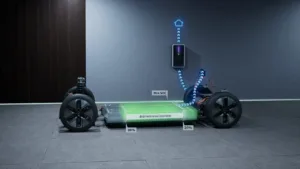
More interestingly, he highlighted three technologies that could significantly change how we use electric vehicles. First is vehicle-to-grid technology, allowing an EV to act as a household battery, storing electricity when it’s cheap or generated through solar and potentially exporting it back to the grid.
Second is the ability to use an EV as a source of energy resilience, something that could become increasingly important for New Zealand households.
Third is BYD’s FLASH charging technology. With claimed charging capability of up to 1.5 megawatts and charging times potentially under five minutes in compatible vehicles and conditions, the technology could fundamentally change the way people think about EV ownership. Imagine not needing a home charger, not worrying about apartment charging and simply visiting a charging station for a few minutes before continuing your journey.
It’s ambitious, certainly, but it’s also a glimpse into where the technology is heading. And if that infrastructure becomes widespread, the argument for electric motoring becomes considerably stronger.
Giving Older Nissan Leafs A Second Life
One of the most practical conversations we had wasn’t about a shiny new vehicle at all. Instead, it was about giving older Nissan Leaf’s a new lease of life. ECVS was showcasing its battery replacement and upgrade solutions, offering owners of older Leafs an opportunity to avoid sending an otherwise perfectly usable vehicle to the automotive graveyard.
Two battery options are available. A 36kWh upgrade, aimed primarily at first-generation Leafs, costs $10,700 including GST. A larger 62kWh option, which requires a new aluminium battery enclosure and is aimed at later ZE1 models, costs $18,500 including GST.
The actual installation is surprisingly straightforward, with the battery swap taking approximately two to three hours once the replacement pack is available. There is, however, a lead time of around 10 weeks, as batteries are built to order.
It’s an interesting alternative to buying another vehicle, particularly for people who are happy with their existing Leaf but have found its ageing battery increasingly restrictive. And there’s a bigger financial argument here.
One ECVS customer living in the Central Plateau had been spending around $350 a week on fuel. They installed solar, moved to a Leaf with an upgraded battery and dramatically reduced their household fuel costs. Now that’s an EV story worth telling.
Plenty More Electric Choices
Of course, no EV expo would be complete without Tesla, and the Model 3 was present alongside a selection of other familiar electric offerings. Geely was also represented with the EX2 and EX5, while the wider automotive family included Polestar, Lotus and Volvo.
GWM brought plenty of personality to proceedings, combining its vehicles with interactive activities, including a Warriors-themed power-play challenge and reflex testing. Its display included the Haval H7 and the Ora 5, the latter having topped New Zealand’s EV sales charts in October.
Toyota was also present, showcasing its hybrid range alongside the all-electric Hilux BEV. There was even a dismantled Toyota vehicle display, offering visitors an interesting look at what’s underneath the bodywork.
GAC demonstrated its broadening portfolio, including the Aion V, Aion UT and M8, alongside a display looking towards the factory and city of the future.
Chery, JAECOO and Denza added further variety, with Denza particularly interesting thanks to its combination of luxury and serious off-road ability through its plug-in hybrid models.
It was a genuinely diverse collection of vehicles, and one that demonstrated just how quickly the electrified market is expanding.
So, Is New Zealand Ready For EVs?
After spending time walking the stands, talking to manufacturers, meeting technology providers and watching people climb into vehicles for test drives, I’d suggest the answer is yes. But perhaps more importantly, I think New Zealand is finally getting comfortable with the idea of EVs.
The technology is improving, the choice is expanding and the prices are becoming increasingly competitive. We’re also fortunate to have a relatively renewable electricity supply, growing numbers of households with solar and a charging network that compares favourably internationally.
There are still challenges. The technology displays at the expo could have gone further, and a few dancing robots didn’t exactly convince us that the future had arrived. But that’s almost beside the point.
The real attraction was the cars, the technology that makes them work and, crucially, the opportunity for visitors to actually drive them. Because you can read about an EV, watch a video about an EV or listen to someone tell you how wonderful an EV is. But until you get behind the wheel, you’re only getting half the story.
The first New Zealand EV & Tech Expo showed that the market has matured beyond the early-adopter stage. There are now electric vehicles for commuters, families, businesses, adventure seekers and those simply looking for a more economical way to get around.
Are EVs perfect? No. Are they right for everyone? Not necessarily. But the days of dismissing them as an automotive fad are well and truly behind us. The future is arriving, and judging by the crowds at this expo, plenty of Kiwis are ready to take it for a spin.