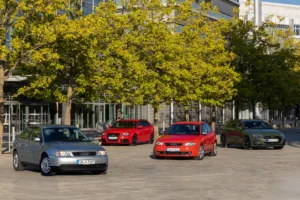
Audi is marking three decades of the A3, a compact line that has passed six million units and grown from a three-door hatch into a family that includes a cabriolet, a crossover and a 400PS RS 3.
Thirty years ago, a premium badge on a small hatchback was still an unusual idea. Now Audi is celebrating three decades of the A3, which premiered at the 1996 Paris motor show. Since then, more than six million have been built.
Audi says the A3 created the premium compact class. That’s the brand’s own framing, but the car’s importance is hard to argue with. It has been delivered to more than 100 countries and is one of Audi’s most successful model lines.
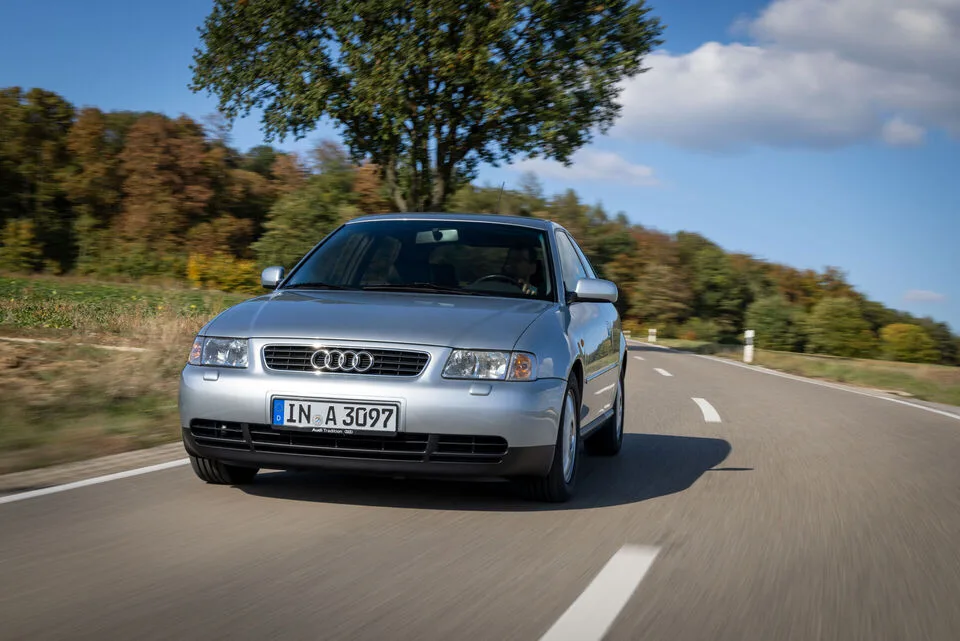
A Coupé-Like Start and Compact Quattro
The original A3 (8L) launched as a three-door hatchback. A rising shoulder line, strong C-pillars and a low glasshouse gave it a coupé-like look. Buyers could pick Attraction, Ambition or Ambiente trims. Over the model’s life they could also choose from four petrol and four diesel engines.
The big step came in September 1998, when quattro all-wheel drive arrived in the compact segment. Because the engine was mounted transversely, Audi fitted an electronically controlled multi-plate clutch ahead of the rear differential.
A five-door followed in 1999, along with the first S3. Its 1.8-litre turbo four made 154kW (210PS) and drove all four wheels through a six-speed manual. Output rose to 165kW (225PS) in 2001.
Sportbacks, Soft Tops and Five Cylinders
The second-generation 8P arrived in 2003. It was longer, wider and roomier inside, with four- and six-cylinder engines. The most powerful versions could be ordered with a dual-clutch gearbox, and a new four-link rear suspension improved both handling and ride.
The Sportback followed in 2004, with a wheelbase 65mm longer than the previous five-door. It was also the first A3 to wear the Singleframe grille. Audi says the Sportback is still the A3’s best-selling body style. A fabric-roofed Cabriolet joined the range in 2008.
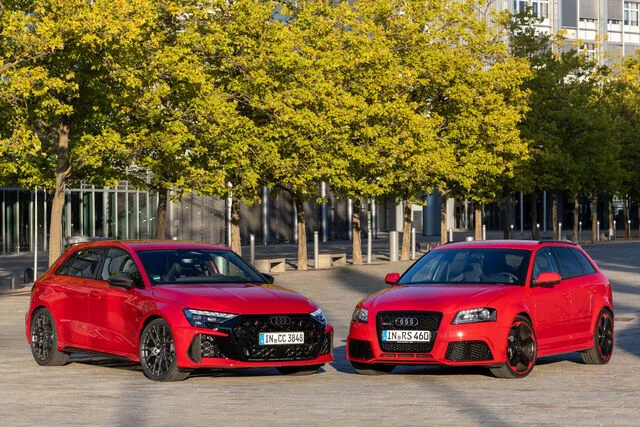
Then, in 2011, came the RS 3 Sportback. Its 250kW (340PS) five-cylinder brought that engine layout into the compact class. Now we’re talking.
Platforms, Plug-Ins and Torque Splitters
In 2012, the third-generation 8V became the first Audi built on the MQB platform, with aluminium used to cut weight. It also brought cylinder-on-demand, which shuts down two cylinders under light load. A Sedan followed in 2013 and drew new buyers, especially outside Europe.
Next, the A3 Sportback e-tron became Audi’s first compact plug-in hybrid in 2014. Meanwhile, the RS 3 kept climbing. The Sportback rose to 270kW (367PS), and the 2016 RS 3 Sedan made 294kW (400PS).
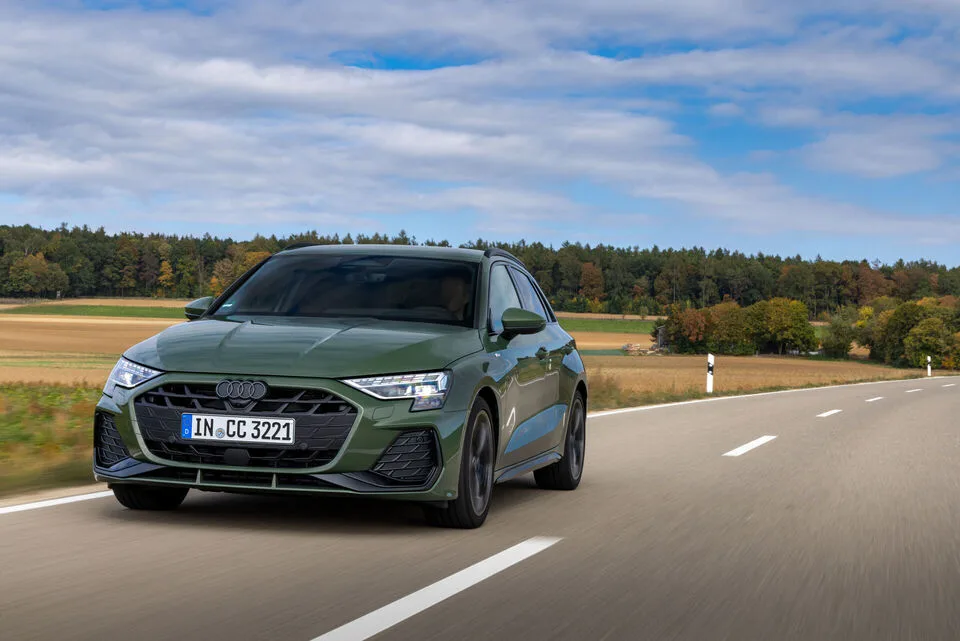
The current 8Y generation arrived in 2020, with 48-volt mild hybrid tech on some engines. Its RS 3 followed in 2021 and replaced the old Haldex system with a rear torque splitter. Audi quotes 0-100km/h in 3.8 seconds and a 290km/h top speed, and calls those figures best in class.
Then, in 2024, the A3 allstreet added 30mm more ground clearance than the Sportback (a crossover was perhaps inevitable). The S3 also got the torque splitter and 245kW (333PS).
Built on Three Continents
Ingolstadt has built the A3 since day one. Because of strong demand, production was added in 1999 at São José dos Pinhais in Brazil. In the early 2000s it expanded again, to Audi Hungaria’s Győr plant.
Few nameplates cover both a compact plug-in hybrid and a 400PS five-cylinder sedan. The A3 has done both, and over 30 years it has kept Ingolstadt’s production lines busy throughout.