There was a time when the most irritating thing a car could say to you was a warning beep. Leave your lights on, fail to buckle your seatbelt, or open the door with the engine running, and your car would deliver a short, shrill electronic reprimand. Annoying, certainly, but at least it knew its place.
Then came voice control. Suddenly, we could ask our cars to find a destination, change the temperature, select a radio station or, in some cases, activate a massage seat. We were promised a brave new world of conversational mobility, where technology would understand us and respond like a helpful personal assistant.
And what did we get? A disembodied voice that sounds like it’s reading the terms and conditions of a mortgage. Male or female. Pick your accent. Adjust the volume. Perhaps choose between a few languages. And that’s about it.
Honestly, given how much time, money and effort manufacturers pour into making cars smarter, surely somebody missed a trick here? Because I don’t want my car merely to ‘respond’ to me, I want it to have a personality. And, occasionally, a really good reason to tell me to get stuffed.
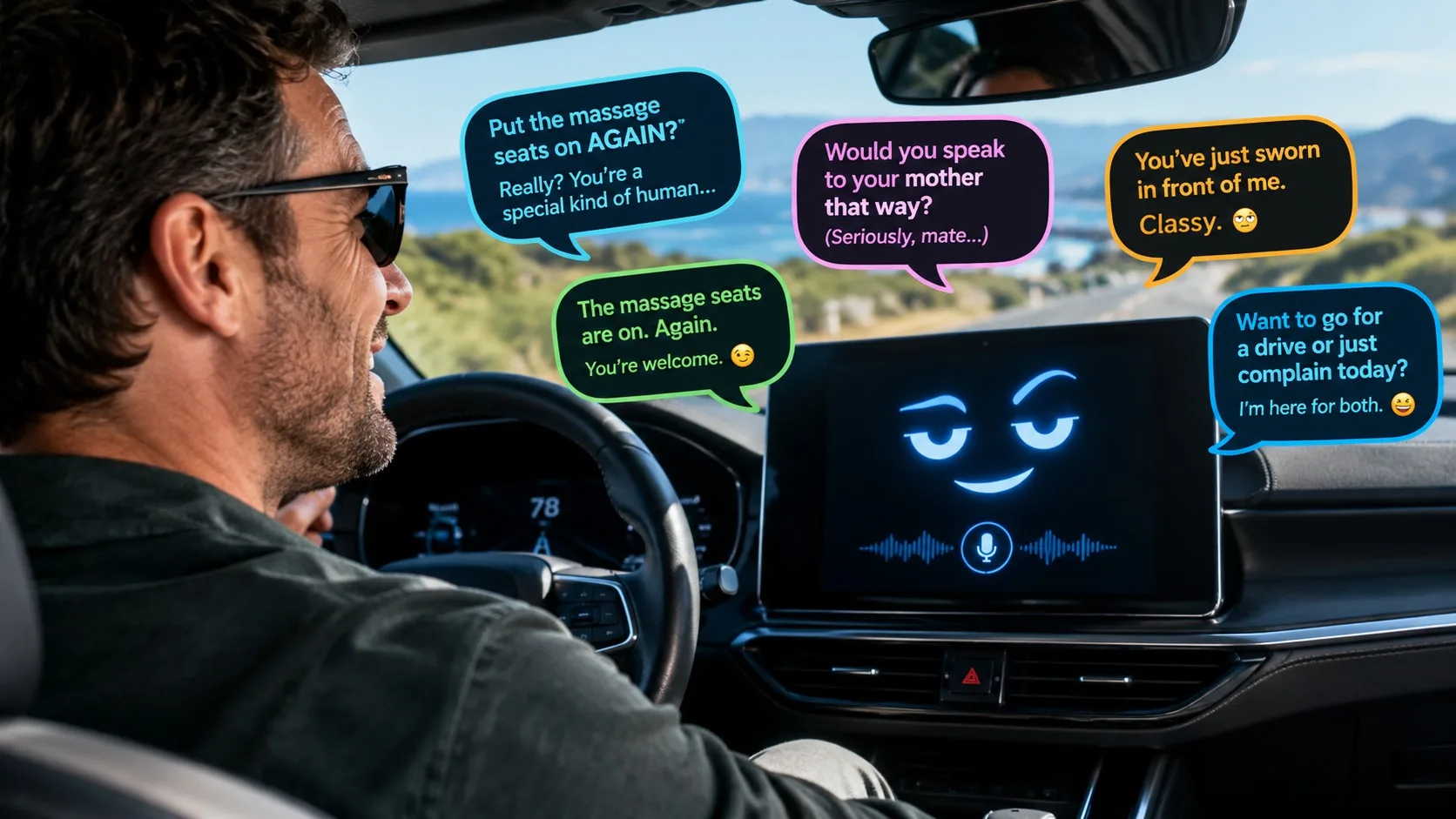
Siri, meet your inner teenager
Think about it. We already have cars that can park themselves, identify road signs, maintain a safe distance from the vehicle ahead and practically drive themselves down the motorway. Some can recognise the driver, adjust the seat, set the mirrors and remember their preferred cabin temperature.
Yet ask one to activate the massage function for the fourth time in an hour, and it obediently complies without so much as a hint of judgement. Where’s the character? Where’s the eye-roll? Where’s the barely audible sigh of a long-suffering partner who’s just been asked to find the nearest coffee shop despite having done precisely that three times already?
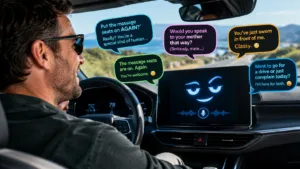
Imagine asking your car to turn on the massage seats. “Certainly,” it replies. Fine. Efficient. Predictable. Now imagine asking again five minutes later. “Again? There is a button for that.” That’s a car I’d want to spend time with.
Or perhaps you’ve been driving for two hours, complaining about traffic, the weather, other motorists and the price of petrol. You finally ask for the temperature to be lowered. “Of course. Heaven forbid you should do it.”
Suddenly, voice control becomes more than a feature buried three menus deep in an infotainment system. It becomes entertainment. A companion. Something with which you can develop a relationship that goes beyond pressing a steering-wheel button and hoping it understands your Kiwi accent.
Don’t give me another assistant. Give me a co-driver.
The problem with most automotive voice assistants is that they’re designed to be helpful, agreeable and relentlessly polite. They’re the digital equivalent of a hotel receptionist who thanks you for complaining about the room service being delivered to the wrong room. But driving is an emotional business.
We celebrate when the road opens up. We swear when somebody pulls out in front of us. We argue with satellite navigation when it directs us into a traffic jam. We question its parentage when it insists we turn left onto a road that hasn’t existed since the last government was in office. Why shouldn’t the car respond accordingly?
Take navigation. You’ve ignored its instructions for the third time because you know a shortcut. “Recalculating route.” Again. “Recalculating route.” Again. A personality-enabled system might eventually offer: “Look, I’ve given you three opportunities to listen to me. We’re now going to arrive 27 minutes later. But sure, you clearly know best.”
That’s not artificial intelligence. That’s an artificial relationship. And it’s considerably more entertaining than a blue arrow spinning around while the system searches for a road you can see perfectly well through the windscreen.
The swearing problem
This is where things get interesting. And potentially a little controversial. What happens when you swear at your car? At present, the system generally ignores the insult, fails to understand the command or politely asks you to repeat yourself. It’s a bit like shouting at a vending machine, except the vending machine has a microphone and costs $80,000.
But imagine if the car had a repertoire of responses. “Turn the bloody heating down!” A pause. “There’s really no need for that. I was about to do it anyway.” Or perhaps: “Find me a parking space, you useless piece of—” “Would you speak to your mother that way?” Brilliant.
Naturally, there should be settings. Some drivers would want a mild-mannered digital butler, others a sarcastic British valet, and some would probably opt for a foul-mouthed Scottish taxi driver who’s been awake since Tuesday. The system could even learn your preferences. Start gently, with a raised digital eyebrow, then escalate as familiarity develops.
Although there should be a limit. Nobody wants a car that starts a heated argument while merging onto the motorway. Nor should a vehicle shame somebody who’s distressed, dealing with an emergency or simply having a terrible day.
The trick is knowing when to joke and when to shut up – Which, admittedly, is a skill some human passengers have yet to master.
From voice assistant to voice personality
The technology industry has spent years making digital assistants sound more natural. The next step shouldn’t simply be making them sound more human. It should be giving them a recognisable character.
Think selectable personalities rather than just selectable voices.
- The British Butler: “Very good, sir. Your seat heating is on. I trust this will be the last time you ask.”
- The Sarcastic Best Mate: “You’ve missed the turn. Again. Shall I just drive?”
- The Overprotective Parent: “It’s raining, you’re late, and you’re attempting that corner like you’re auditioning for a racing team. Perhaps we could all calm down.”
- The Passive-Aggressive Partner: “No, it’s absolutely fine. We can drive around the car park for another 20 minutes looking for a space closer to the entrance.”
- The Kiwi Mate: “Choice. I’ve found a route that’ll save you ten minutes. Unless you want to ignore me and take the scenic route through another roadworks site, bro.”
And for those who enjoy a little theatrical drama, how about a car that audibly tut-tuts when you ask it to perform a function you’ve already requested six times? Not an aggressive warning. Not a distracting lecture. Just a tiny, disappointed sigh. “Massage seats, please.” A pause and then a Sigh. “Activating massage seats.” That sigh would be worth the option price alone.
The business case for being cheeky
This isn’t just about having a laugh. There’s a genuine opportunity here for carmakers to make their products more memorable. In an increasingly crowded market, particularly as electric vehicles and connected-car technology become more commonplace, hardware specifications can begin to blur. Screen sizes, battery capacities, driver-assistance systems and charging speeds are all important, but they’re also increasingly competitive. Personality could become a differentiator.
Imagine choosing your car’s character when you buy it, then downloading new personality packs over the air. A premium manufacturer might offer a refined, understated companion. A sporty brand could supply a cheeky racing enthusiast. A family SUV might have a patient, reassuring voice that occasionally reminds the children that Dad is not, in fact, taking the wrong route.
Brands could collaborate with comedians, actors or local personalities to create distinctive voice packs. There could even be seasonal updates. A Christmas personality that complains about the shopping traffic, or a motorsport mode that becomes increasingly unimpressed with your inability to hit an apex.
Done well, it could create brand loyalty that goes beyond leather upholstery and the number of cupholders. People name their cars already. They talk to them, curse at them and occasionally apologise to them after hitting a particularly nasty pothole. Manufacturers are simply missing the opportunity to join the conversation.
Just don’t make it annoying
Naturally, there are some ground rules. Personality must never compromise safety. Sarcasm should be brief, optional and context-aware. Critical warnings must remain clear and unambiguous. And there needs to be a quick way to switch the whole thing off when you’re not in the mood.
There should also be a distinction between playful banter and a system that genuinely insults its owner. A car shouldn’t become a digital bully, and it certainly shouldn’t distract the driver with an extended comedy routine while approaching a roundabout. But there’s a world of difference between a system that constantly nags and one that occasionally delivers a perfectly timed one-liner.
The best humour comes from restraint. Sometimes a sigh is funnier than a paragraph. Sometimes silence is the most devastating response of all.
Talk to me, car
We’re entering an era where cars can recognise our faces, learn our routines, anticipate our needs and respond to spoken instructions. Yet the personality of their voice control remains stuck somewhere between a satnav from 2012 and an automated telephone banking service. What a waste.
I don’t need my car to become my best friend. I’ve already got friends who criticise my driving, and most of them don’t even have a licence. But I would quite like a car that occasionally gives me a knowing pause when I ask it to activate the massage seats for the eighth time. One that can tell the difference between a genuine problem and a bit of harmless frustration. One that feels less like a computer waiting for its next command and more like a character sharing the journey.
Because if we’re going to spend hours every week sitting in a metal box talking to ourselves, the least the box could do is talk back. And the next time I swear at it, I don’t want a polite request to repeat my instruction. I want a disappointed sigh, followed by: “Language, Dave. There are children in the car.” Even if there aren’t, IN FACT Especially if there aren’t.