Picture this: a minivan, gracefully cruising through the twisting urban labyrinth of Yokohama’s Minato Mirai, with no one at the wheel. This isn’t a scene from a sci-fi flick; it’s Nissan’s audacious leap into the fully autonomous era. A first in Japan’s history, Nissan Motor Co., Ltd. has unveiled its latest autonomous-drive (AD) technology, designed to redefine mobility solutions across the country.
Nissan’s autonomous driving ambitions are not about building cars that drive themselves simply for the wow factor – they aim to tackle real-world problems. Japan’s aging population has led to an escalating shortage of drivers in local communities, threatening essential transportation services. Nissan’s proprietary AD technology, developed with this context in mind, aims to enable people to break free from such logistical challenges, revitalizing “freedom of mobility” for all.
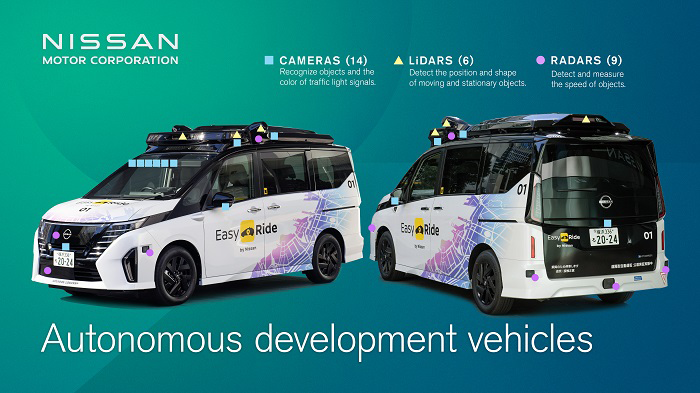
At the heart of Nissan’s test vehicles is the Serena, Japan’s best-selling minivan-turned-tech trailblazer. Imagine a mechanical marvel that’s brimming with 14 cameras, nine radars, and six LiDAR sensors—hardware that could make even the gadget arsenal of James Bond’s iconic car look modest. These instruments are perched high atop the minivan, optimizing their ability to detect surroundings courtesy of the Serena’s notable stature. But it doesn’t end there. Nissan has harnessed the wizardry of artificial intelligence to supercharge the car’s ability to recognize objects, predict behavior, and execute smooth, split-second decision-making in dense and unpredictable urban environments.
Of course, Nissan isn’t cutting corners in the safety department. Engineers have stress-tested these vehicles for countless scenarios, ensuring they’re equipped with emergency stop functions and layered redundancies for fail-safe operations. Further, the cars are remotely monitored, with an operator ready to take control if necessary. It’s autonomy with a safety net, a pragmatic blend designed to navigate not just roads but regulatory hurdles as well. Nissan’s AD tests align with Japan’s SAE Level 2 automation standards for vehicles using remote autonomous driving systems.
But let’s not mistake these trial runs as mere tech demos. Nissan has grander plans in motion. Between the fiscal years 2025-2026, they will launch a demonstration fleet of 20 vehicles in Yokohama, figuring out the nuts and bolts of an operational framework in collaboration with municipalities and transportation stakeholders. And by 2027, expect these AD mobility services to hit commercial streets, supported by Japan’s government ministries and the Level 4 Mobility Acceleration Committee. Think of it as the country’s bureaucratic green light to fast-track self-driving tech.
Nissan’s behind-the-scenes global collaboration has also been a critical engine driving this innovation. From Japan’s thriving tech labs to Silicon Valley’s trailblazing mindset and deep research insights gleaned from the U.K.’s evolvAD project, Nissan is uniting the world’s best thinkers to create a seamless autonomous driving ecosystem. It’s a high-stakes relay race, and Nissan is tightening its grip on the baton.
This initiative isn’t confined to Yokohama’s streets or Japan’s borders, it’s the dawn of a new mobility revolution, one where driverless minivans might just turn the daily grind into a scene worthy of stunned double-takes and whispered awe.