Mazda’s latest Integrated Report confirms that its next-generation Skyactiv-Z engine technology will reach a new inline-six family, and it briefly mentions a possible rotary application.
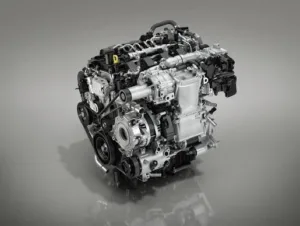
Most carmakers are winding down their combustion engine programmes. Mazda is building new ones. In its annual Integrated Report, published in Japanese, the company says it is applying its upcoming Skyactiv-Z technology to a new family of inline-six engines.
The report also suggests the same technology could appear in a rotary engine. That was a single line with no details at all, but it will still get enthusiasts talking.
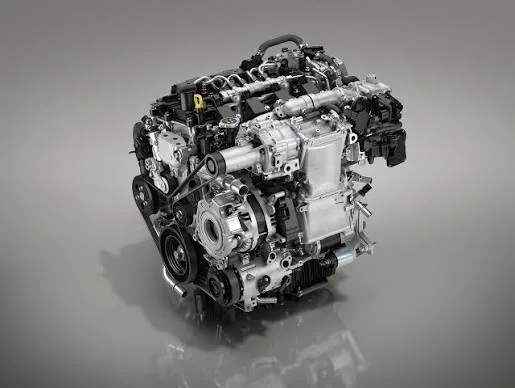
A Four-Cylinder First, Then Six
Skyactiv-Z begins as a four-cylinder engine. Its first application arrives next year in a hybrid version of the CX-5, which will also be Mazda’s first use of the new petrol-electric technology.
The inline-six family comes next. Mazda has said that Skyactiv-Z was developed much faster than the earlier Skyactiv-G and Skyactiv-X engines. If that holds, the technology could adapt to other layouts fairly quickly. Mazda has not said which models will get the six or whether it will be hybridised or turbocharged. However, the longitudinal straight-six already in the CX-90 looks like an obvious candidate.
Learning From Skyactiv-X
Skyactiv-X did not succeed commercially, but Mazda says Skyactiv-Z will build on its compression-ignition approach. That system used a small spark to create a pressure wave in the combustion chamber. The wave then ignited a lean fuel and air mixture.
This time, Mazda plans to insulate the whole engine so less heat escapes. It says that keeping more heat in the combustion chamber will improve both power and efficiency, even with a leaner mixture than Skyactiv-X used. Those are Mazda’s own targets for now. The company has not explained exactly how the system works.
Why Mazda Is Sticking With Combustion
Mazda says it wants to stay a “front-runner” in internal combustion. Its reasoning is practical. Many markets still lack the charging infrastructure for full electrification, so efficient petrol engines remain important, whether alone or paired with hybrid and plug-in hybrid systems.
That doesn’t mean Mazda is ignoring EVs. The report confirms that an in-house electric platform is coming, and the company expects to share its development costs with corporate partners. One of those could be Changan, Mazda’s partner in the joint venture behind the 6e sedan and CX-6e crossover. Mazda has not given a timeline or other details for the platform.
What It Means for the MX-5
Mazda is also developing the next MX-5. That car will not use the current powertrain. In Europe, emissions rules have already ended the 2.0-litre four-cylinder.
Chief executive Masahiro Moro has said the next MX-5 needs to be “EV-ready”. A hybrid seems likely, although Mazda has not confirmed one. Reports also say Mazda wants to keep the roadster’s current kerb weight. Adding a battery would therefore mean saving weight somewhere else, which is a difficult target for a car that is already light.
The straight-six is the confirmed part of this news. The rotary mention is a hint and not a plan, but it shows Mazda still treats the rotary as part of its future engine work.