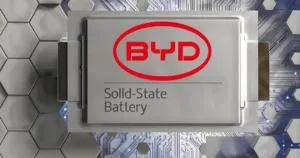
BYD executive Stella Li says a vehicle fitted with the company’s solid-state battery technology will appear next year, though mass production remains years away.
BYD plans to put a vehicle equipped with solid-state battery technology on the road next year, according to Executive Vice President Stella Li. She confirmed the timeline in an interview with Carwow.es in Valencia, Spain, though she stopped short of naming a model or promising a retail launch.
“BYD is in the leading position; we’re in the leading position for the commercial line, and for the technology,” Li said, adding that the company will use a vehicle demonstration to prove that claim. She did not give a production date, battery specifications, or performance figures.
What BYD’s Battery Arm Is Actually Building
The work sits with FinDreams, BYD’s battery division, which is developing an inorganic sulfide solid-electrolyte chemistry using lithium phosphorus sulfur chlorine (LPSC) materials. The company has reported 20 Ah and 60 Ah prototype cells targeting energy density near 400 Wh/kg.
That figure applies to individual cells, not complete battery packs, so it doesn’t guarantee equivalent real-world range or performance once the technology is built into a full vehicle.

Why Solid-State Batteries Are Hard to Scale
Sulfide chemistry offers strong ionic conductivity, but the jump from lab cell to automotive pack brings fresh problems. Solid-to-solid contact between electrodes can degrade as they expand and contract, and some designs need sustained mechanical pressure just to hold together.
Manufacturing adds further complexity. Standard wet electrode processing uses solvents that react badly with sulfide electrolytes, pushing FinDreams toward dry processing methods it is still scaling with equipment suppliers. Moisture control matters too, since sulfide electrolytes can release hydrogen sulfide gas if exposed to water.
A Longer Road to Mass Production
FinDreams Chief Technology Officer Sun Huajun has previously outlined a staged rollout: small trial runs of roughly 1,000 vehicles around 2027, followed by large-scale production around 2030. Early use is expected on premium platforms such as Yangwang and flagship Denza models, where higher costs are easier to absorb.
Specialised sulfide precursor materials currently cost many times more than conventional liquid-electrolyte materials.
BYD is also working within CASIP, a government-backed Chinese research platform tied to state solid-state battery funding. BYD Chief Scientist Lian Yubo has said liquid lithium-ion and solid-state batteries could coexist for 15 to 20 years.
Where This Leaves BYD Against Rivals
BYD isn’t alone in chasing this technology. Toyota is targeting a 2027-2028 launch for solid-state electric vehicles through its Idemitsu Kosan partnership, while Samsung SDI has set 2027 for its own mass production goal.
Those overlapping timelines don’t settle who leads the race. Next year’s demonstration vehicle will show whether BYD’s chemistry works outside the lab, but the bigger test, turning that into affordable, high-volume production, remains firmly on the 2030 horizon.