The Audi Q9 is the first production car with a three-dimensionally curved digital OLED panel, built on hair-thin glass and backed by a micro-LED headlight system.
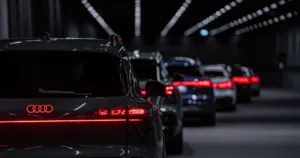
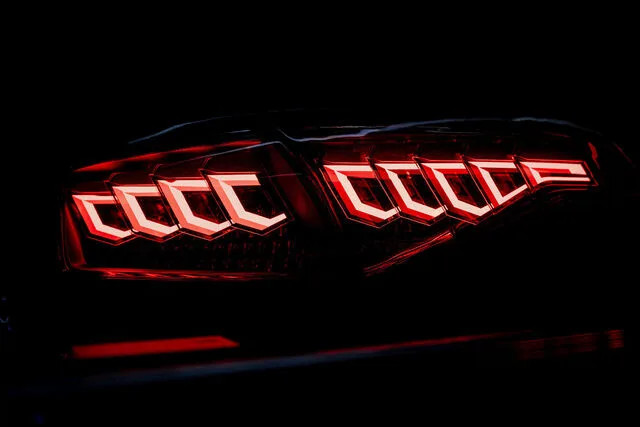
Rear lights used to have a simple brief: glow red and get brighter when you brake. Audi has spent a decade asking them to do rather more. The new Q9 takes the next step with what Audi calls the industry’s first three-dimensionally curved digital OLED panel in a production car.
Glass as thin as a hair
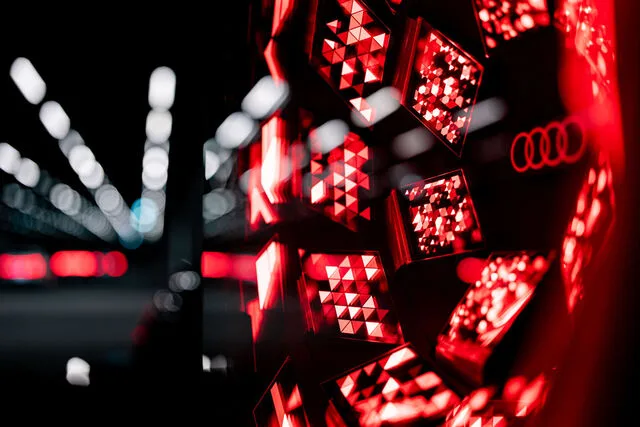
The breakthrough comes from the glass. Each panel’s carrier glass is just 0.1mm thick, roughly the width of a human hair. As a result, the panels can bend to a radius of up to 200mm and follow the contours of the body instead of sitting flat behind a lens.
The curve isn’t only there for looks. Audi places the OLEDs in the outer sections of the rear lights, so drivers can still see them from wider angles to the side. Audi says the panels are designed and validated to automotive requirements for durability, uniformity and contrast.
512 segments and eight signatures
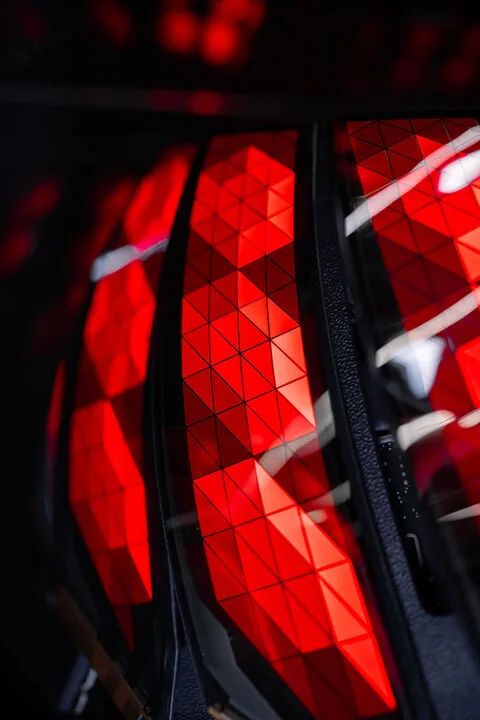
The Q9’s third-generation rear lights use 512 digital segments spread across six panels. The curved panel alone carries 99 segments, which makes it the largest OLED panel Audi has fitted to a production vehicle.
Owners can choose from up to eight digital light signatures at the front and rear. One option is new: a semi-active signature that sits between static and fully animated, which Audi says produces three-dimensional effects at night. Personalised tail-lights might sound frivolous, but the same segments also do safety work. The communication light can show warning symbols within the signature to alert other drivers to accidents or breakdowns ahead.
Ten years in the making
The Q9 continues a steady progression:
- 2016: The TT RS introduced OLEDs as a production rear-light technology.
- 2020: The Q5 digitised them, allowing individual segment control and selectable signatures.
- 2024: The Q6 e-tron brought the second generation, with ten times the segments and warning symbols for breakdowns, emergency braking and accidents.
Why not just use a phone-style OLED screen? Audi points out that displays can’t reach the brightness the law requires for rear and brake lights. Its own segments are purpose-built and can be dimmed continuously.
Micro-LEDs up front
The headlights are just as dense. The Q9’s digital Matrix LED unit uses a micro-LED module packing 25,600 individual LEDs into a space about 13mm wide, each roughly 40 micrometres across. That allows the system to project high-resolution light images and adjust its beam pattern, which Audi says helps most in poor weather.
Functions include lane lighting, orientation lighting on rural roads and turn-signal projection on motorways. In narrow roadworks, the system can swap lane lighting for orientation lighting to help the driver stay centred. Meanwhile, the advanced turn signal, first seen on the Q7, projects a dynamic indicator onto the road when turning or changing lanes at night. Audi notes that these aids only work within the system’s limits.
Lights that talk
Taken together, Audi is treating its lights as exterior displays rather than lamps. The curved glass is clever engineering, but the warning symbols matter more in practice. They only help if drivers behind the Q9 understand what they are being told.