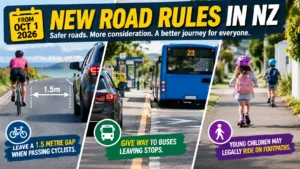
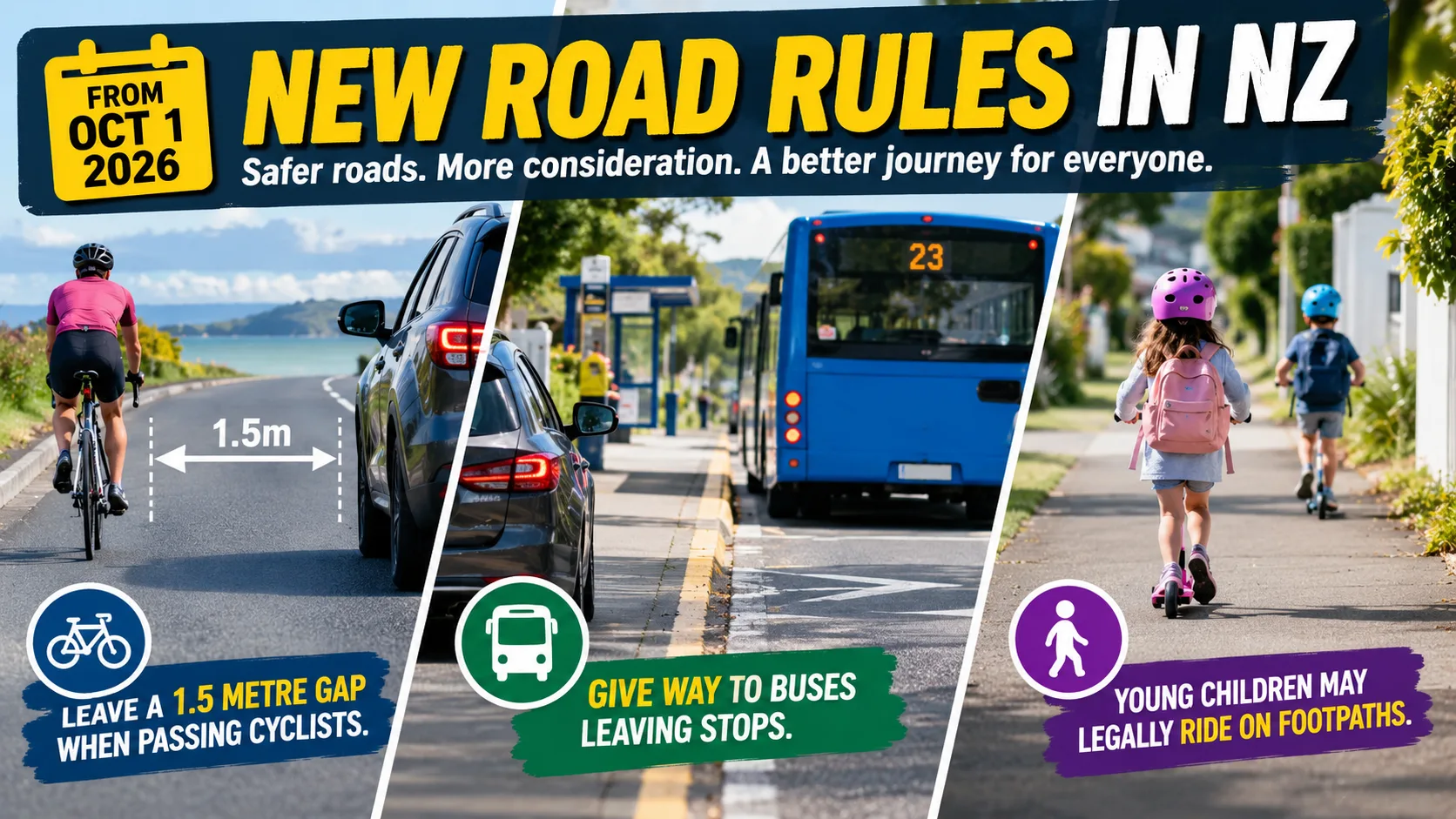
From October 1, 2026, New Zealand drivers must leave a 1.5-metre gap when passing cyclists and give way to buses leaving stops, while young children may legally ride on footpaths.
How much room do you give a cyclist when you pass? From next month, New Zealand law gives one simple answer: at least 1.5 metres. The new passing gap is one of four road rule changes due to take effect on October 1, 2026. They affect drivers, cyclists, e-scooter riders and bus users.
The changes are part of the Government’s Land Transport Rules Reform Programme. They follow a public consultation that drew feedback from more than 6000 individuals and organisations. The Government says it wants the rules to be clearer and to better match how Kiwis actually use roads and footpaths.
One Passing Distance for Everyone
For drivers, the biggest change is the mandatory 1.5-metre gap when overtaking cyclists, horse riders and other road users. The minimum distance used to vary with the circumstances. Now it will be one figure, whatever the situation.
The Government says consultation feedback led to the simpler rule. Frankly, one number is much easier to remember than a sliding scale.
Footpaths Open to Young Riders
Families on bikes will also notice a difference. Children aged 12 and under will be legally allowed to ride on footpaths. Parents, caregivers, teachers and older siblings can ride alongside them.
That second part was not in the original plan. The Government first proposed opening footpaths only to children. However, submitters pointed out that sending the accompanying adult out onto the road could undermine the safety benefit. So the final rule lets an older rider stay on the footpath with the child.
E-Scooters and Buses
E-scooter riders get formal permission to use cycle lanes. Meanwhile, drivers have a new give-way obligation. On roads with speed limits of 60km/h or less, road users must give way to buses pulling out from bus stops.
For anyone who drives regularly through town centres, that is the change most likely to show up on a daily commute. The package also includes several minor technical updates covering road signs, signals and markings.
The Rule That Did Not Make It
Not every proposal survived consultation. The Government consulted on five changes between February 25 and March 25, 2026. One of them aimed to clarify rules and signage for parking on berms.
That idea received mixed feedback and relatively low support. As a result, Transport Minister Chris Bishop chose not to proceed with it. Berm parking, it seems, will remain a matter for local debate a little longer.
Bigger Reforms on the Horizon
The new rules are expected to start on October 1, once the necessary Orders in Council are in place. Road users, councils and advocacy groups all helped shape the final package.
These four changes are only the first step. The same reform programme is also set to enable digital driver licences and universal road-user charges for all light passenger vehicles. The second of those will cost motorists far more than a 1.5-metre gap ever will.