Silverstone has hosted the British Grand Prix since 1948, and its corners are identified not by numbers but by names. Each one points to something real, a demolished chapel, a wartime runway, a rival circuit, a royal club. Ahead of the 2026 British Grand Prix, it is worth tracing exactly where those names came from.
The Opening Lap: Abbey to The Loop
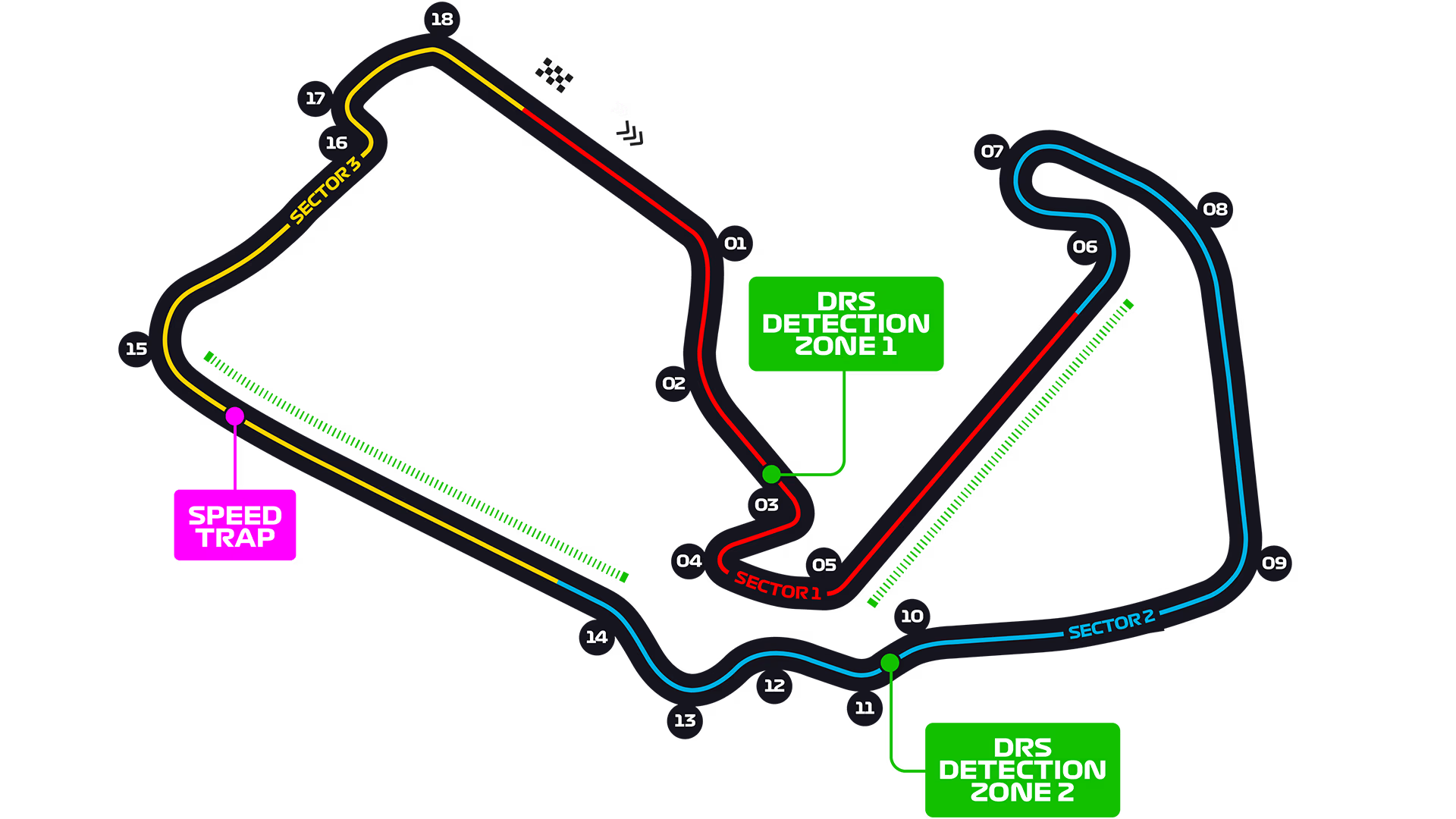
Drivers leave the grid along the Hamilton Straight, named in honour of Lewis Hamilton, Britain’s most successful Formula 1 driver. The first corner, Abbey, takes its name from Luffield Abbey, the remains of a medieval monastery found near the site.
Farm Straight recalls a farm that stood beside the original circuit layout. The 2010 reconfiguration turned it into a curve, but the name stayed. Village, the first significant braking point, refers to the nearby settlement that also gave Silverstone its name, and now houses team facilities for Aston Martin and Cadillac.
The Loop is straightforward: it describes the shape. It is the slowest point on the circuit and a key energy-harvesting zone under the 2026 regulations.
Military History and Rival Circuits
Aintree at Turn 5 acknowledges the Liverpool venue that hosted the British Grand Prix five times between 1955 and 1962. The Wellington Straight follows, named after the Vickers Wellington bombers that flew from this land during the Second World War, the straight itself was formed from one of the original RAF runways.
Brooklands at Turn 7 honours the oval circuit south of London that staged the very first British Grand Prix in 1926. Luffield, the long right-hander that follows, circles back to the same abbey that gave Abbey corner its name.
Woodcote at Turn 8 references Woodcote Park, a stately home on land owned by the Royal Automobile Club, the organisation whose members helped establish Silverstone as a racing venue in the first place.
Copse, Maggotts, Becketts, and the Back Straight
Copse is named for the small woodland clusters (copses) that surround this part of the circuit. Drivers take it near flat. Then comes the most celebrated sequence: Maggotts, named for Maggots Moor beyond the grandstands, flows into Becketts and Chapel Curve, both recalling a medieval chapel dedicated to former Archbishop of Canterbury Thomas Becket. The chapel was demolished in 1943 to make way for the airfield.
The Hangar Straight follows, named for the two large aircraft hangars that once stood here. It remains one of the best overtaking opportunities on the calendar. Stowe at the end of the straight is a notoriously difficult corner — and the place where Michael Schumacher broke his leg during the 1999 race. Local legend holds that students from nearby Stowe School were among the first to suggest racing around the abandoned airfield.
The Final Sector
Vale at Turn 16 has a disputed origin. One theory points to a slight change in elevation; another suggests it simply reflects the corner’s location within the Aylesbury Vale district. Either way, nobody is entirely certain.
The lap closes at Club, a final nod to the RAC’s London clubhouse. The club’s connection to Silverstone is also marked by the gold trophy awarded to the British Grand Prix winner, a trophy that must be returned after the podium, with drivers receiving a replica. Last year’s replica was made from LEGO.
Taken together, the corner names form an unofficial map of Silverstone’s identity: part wartime airfield, part medieval landscape, part living archive of British motorsport. That layered history is part of what makes the circuit feel different from almost anywhere else on the calendar.