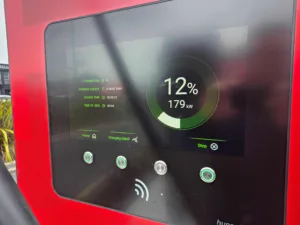
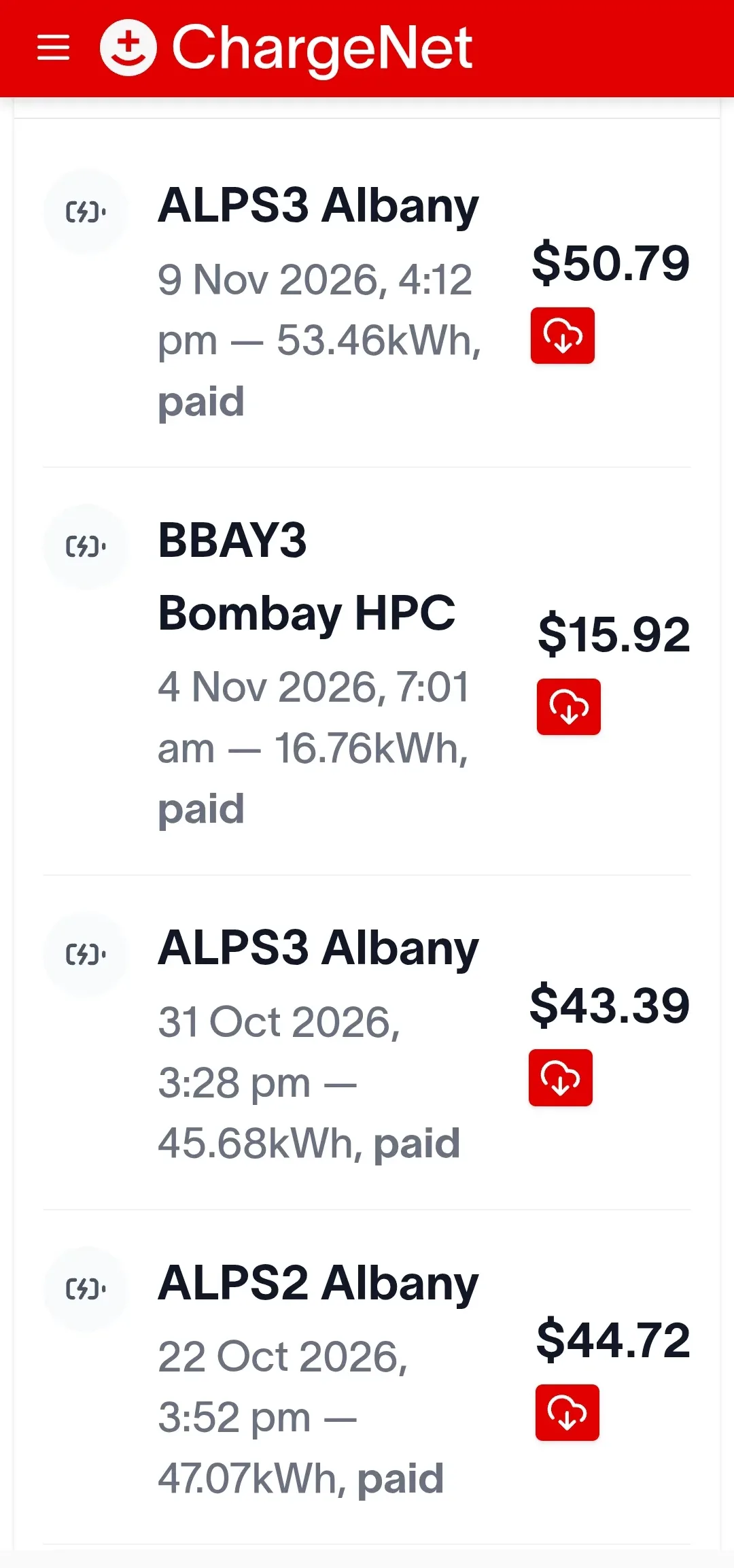
We talk a lot about the cost of petrol, but what about the cost of electricity? I recently paid $50.79 to put 53.46kWh into an EV. Sounds reasonable enough, until you do the maths and discover that, on an energy-equivalent basis, that’s the same as paying $8.45 for a litre of petrol. Suddenly, that charging cable feels a little less attractive.
Let’s get one thing straight from the outset. This isn’t an EV-bashing story. Far from it. Electric vehicles are generally considerably more energy-efficient than their internal combustion engine (ICE) counterparts, and that’s a rather important part of this conversation.
But there’s a difference between being efficient and being cheap to run. And sometimes, the latter depends entirely on where, when and how you charge.
Here’s how I arrived at my rather eye-watering $8.45 figure. I was charged $0.95 per kWh for a charging session totalling 53.46kWh. The bill came to $50.79. Now, for a little perspective, one litre of petrol contains approximately 8.9kWh of energy.
So, if we use that as our energy comparison, 53.46kWh is equivalent to roughly six litres of petrol. Divide the $50.79 charging bill by those six litres and, well, there’s your answer. $8.45 per litre. Ouch.
Of course, this isn’t a direct comparison of what it costs to drive an EV versus a petrol car. Petrol engines waste a considerable amount of energy through heat and mechanical losses, whereas electric motors are much more efficient at turning stored energy into forward motion.
In fact, an efficient EV can deliver the equivalent of around 1.7L/100km when measured against the energy contained in petrol. That’s seriously impressive, and one of the biggest reasons EVs can be so economical to operate.
But here’s where things get interesting. If you’ve got a particularly efficient hybrid that can get close to that sort of real-world consumption, the financial race suddenly becomes a lot closer. Especially when electricity prices start climbing towards the $1/kWh mark.
And New Zealand isn’t the only place where charging prices are getting attention. In the UK, some rapid charging rates can reach £1 per kWh. That’s more than NZ$2 per kWh at current exchange-rate levels, which would push our petrol-equivalent calculation beyond $17 per litre. Yes, seventeen dollars. Suddenly, even premium unleaded starts looking like a bargain.
Of course, not every charger is charging premium prices. Slower public chargers in New Zealand can be found around the $0.45/kWh mark, which brings the equivalent energy cost down to approximately $4.26 per litre. That’s a rather different proposition.
And then there’s home charging. If you’ve got the ability to plug in overnight on an off-peak electricity plan, or better still, use surplus solar generation, the economics can swing heavily back in the EV’s favour. Charging at home is often where EV ownership really starts to make financial sense.
But… and it’s a fairly sizeable but… not everyone has a driveway, a home charger, solar panels or the luxury of planning their charging around cheaper electricity periods. Some drivers rely on public rapid chargers. They’re travelling, they’re in a hurry, or they simply need to put some energy back into the battery. And when that happens, the advertised savings of EV ownership can start looking rather different.
That’s the point I’m trying to make. EVs are efficient. They’re quiet, smooth, increasingly capable and, when charged at the right price, can be remarkably cheap to run. I’m certainly not suggesting we should abandon them because of one expensive charging session. But we shouldn’t pretend that electricity is always cheap, either.
We scrutinise petrol prices down to the cent, yet electricity pricing often gets a free pass in the EV conversation. Perhaps it’s time we started looking at both sides of the equation.
Because paying $8.45 for a litre-equivalent of EV juice certainly gave me a bit of a shock.
The real question isn’t whether EVs are cheaper to run. It’s whether they’re cheaper to run where, when and how you actually use them.