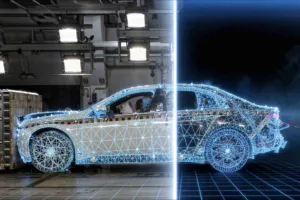
BMW Group is working with French AI company Mistral AI to build a specialised model trained on more than a petabyte of its own crash simulation data, with the aim of making complex engineering work faster and more accurate.
Most carmakers talk about artificial intelligence in terms of voice assistants and touchscreens. BMW’s latest AI project has nothing to do with the cabin. The BMW Group has partnered with Paris-based Mistral AI to use AI in crash simulation, one of the most data-heavy parts of building a car.
The two companies say they want to improve quality, accuracy and speed in complex engineering tasks. BMW calls the project a first step. If it works, the company plans to use similar domain-specific AI in other areas of vehicle development and across its wider value chain.
A Mountain of Crash Data
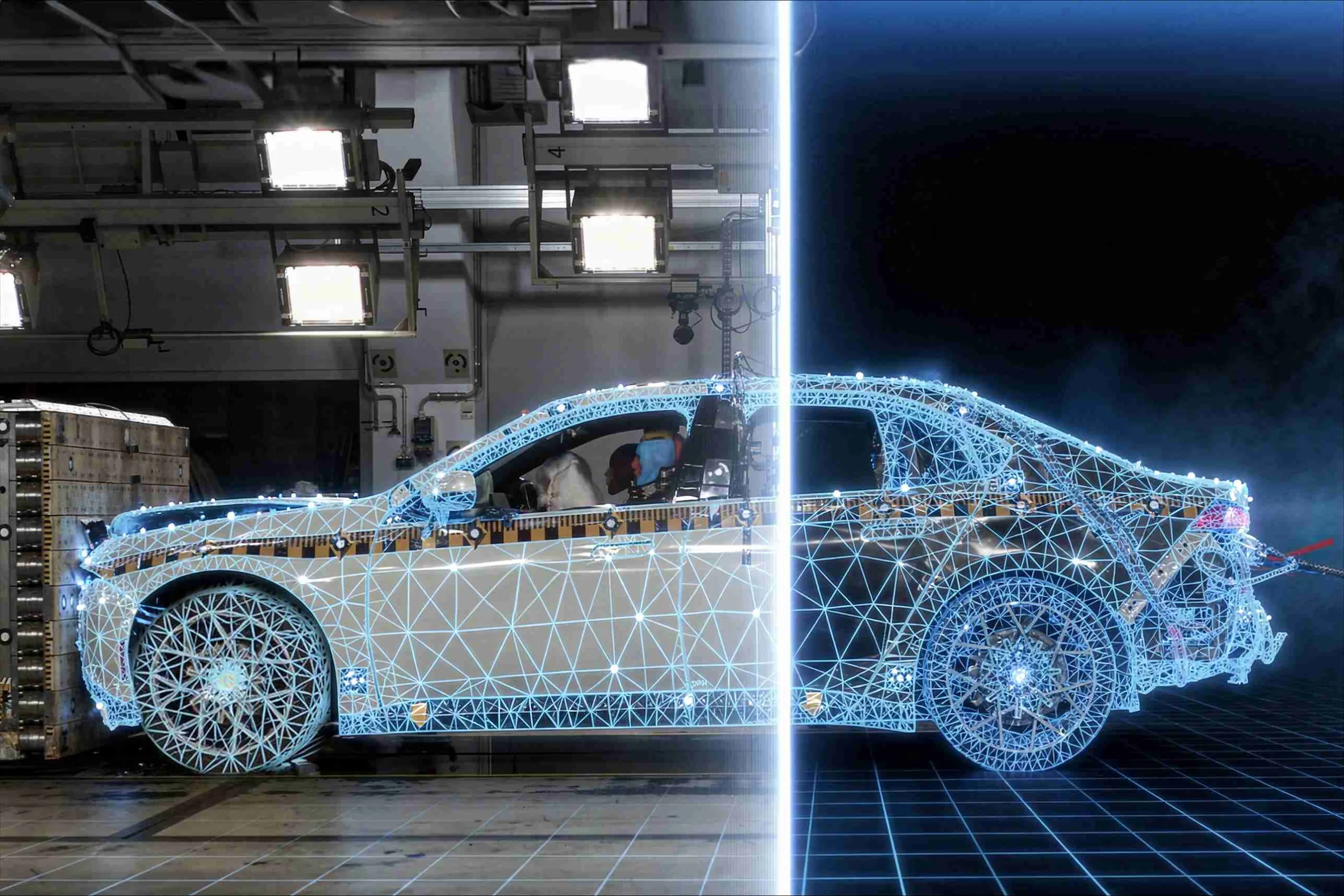
Crash simulation makes a good starting point because of its sheer scale. BMW says it runs thousands of virtual crash simulations every week. Each one produces large amounts of engineering data.
Over the years, that has added up to more than one petabyte of crash simulation data. For context, that is roughly a million gigabytes. The data shows in fine detail how vehicle structures and materials behave, and BMW sees it as a strong foundation for training an industrial AI model.
BMW CIO Dr Franz Decker described industrial data as key to turning AI into value creation. In practice, BMW supplies the engineering datasets and Mistral AI brings its model-training capability. Together they aim to build specialised AI that supports complex development tasks.
Enter the Large Industry Model
To scale this up, BMW is focusing on what it calls Large Industry Models, or LIMs. These AI systems are trained on engineering and simulation data from vehicle development and safety testing, rather than on general internet text.
That is the key difference from general-purpose AI tools. A LIM builds specialist knowledge directly into the model. BMW says that takes more than raw data. It also needs deep engineering expertise and technical environments where the AI can learn directly from BMW’s own development processes.
Mistral AI Chief Revenue Officer Marjorie Janiewicz called industrial AI “the new frontier”. She said the project shows how industry-specific models can help with hard engineering problems such as crash simulation.
What We Don’t Know Yet
For now, the announcement sets out goals rather than results. BMW has not said how much faster or more accurate the AI-assisted work will be. It has not given a timeline either, and it has not said which vehicle programmes will use the system first.
The benefits are the partners’ own claims, and no independent testing has backed them up so far. That is normal for a partnership at this stage, but it matters.
Why It Matters
This is still a more grounded use of AI than most of what the car industry has shown us. Crash engineering produces huge amounts of data and depends on specialist knowledge, which is exactly the kind of problem a well-trained model could help with.
BMW’s real advantage is the data archive. Mistral can train a model, but only BMW owns more than a petabyte of its own crash data. That archive is what could turn a general AI tool into a genuine engineering one.