Tired of Sitting at Red Lights? Here’s What’s About to Change
Ever found yourself staring at a red light with zero cars in sight? Frustrating, right? Well, the City of Moreton Bay just announced something that could turn your daily commute from soul-crushing slog to smooth sailing, Australia’s first AI-powered traffic signal system.
Why Your Commute Has Been Stuck in the 1980s
Here’s the thing, Australia’s traffic signals have been running on basically the same methodology since the 1980s. They operate on a rigid, pre-determined sequence using what’s called “phase-based control,” where traffic lights follow a fixed grouping prioritised on a first-come, first-served basis. Translation? Your traffic light doesn’t care if there are actually cars waiting or not. It just follows the script.
This outdated system is why you sit at empty intersections burning fuel, getting frustrated, and generating unnecessary emissions while staring at a red light that serves absolutely no purpose.
The Solution – Movement-Based Control That Actually Thinks
Enter the future. The new AI-powered system ditches the rigidity entirely and switches to “movement-based” control, meaning each individual traffic movement is managed independently, without being tied to those old pre-determined sequences.
The difference? The system uses advanced AI and algorithms to analyse vehicle movements in real-time, making instant decisions about the most optimal way to control traffic. It’s like upgrading from a traffic control system that runs on auto-pilot to one that actually pays attention.
Mayor Peter Flannery put it perfectly: “The technology effectively uses both AI and advanced algorithms to inform optimised traffic operations under a new traffic management approach.”
What This Actually Means for You
Shorter Wait Times The system has the genuine potential to substantially reduce the time motorists spend unnecessarily sitting at red lights. Fewer empty intersections. Less wasted time.
Smarter Priority System The new technology can prioritise traffic based on road user type – buses, cyclists, and other vehicles get dynamic priority throughout the day. This means higher traffic flows of vehicles including public transport can be adjusted in real-time depending on actual demand.
Fewer Emissions Because vehicles idle less at traffic lights, the system has the potential to reduce emissions. Every second your car isn’t running unnecessarily is a win for the environment and your fuel bill.
Faster Transitions Council is also reducing the transition time between conflicting traffic light sequences while maintaining safe margins. That “all-red” interval when an intersection is empty? That’s getting shorter too.
Where It’s Happening First
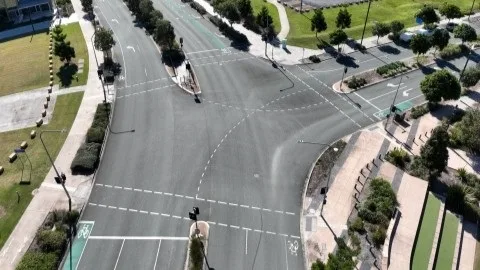
The pilot is launching at the intersection of Moreton Parade and Paper Avenue in Petrie. The new system involves replacing existing traffic signal controllers with next-gen hardware that can make instant decisions about optimal traffic control.The hardware works with both in-ground loop detectors (the existing detection method) and brand-new advanced vehicle detection sensors that classify road user types and predict traffic flow.
What’s Next?
If the Petrie pilot proves successful (and early indicators suggest it will) Council plans to test the technology at a more complex intersection, gradually rolling out this smarter traffic management across the city.
Tarmac Takeaway
Evidently, Australia’s traffic infrastructure has been overdue for a major upgrade. The City of Moreton Bay isn’t just tinkering around the edges; they’re fundamentally reimagining how traffic signals work. By switching from a one-size-fits-all, 1980s-era system to AI-powered, real-time traffic management, they’re proving that sometimes the smartest solution to gridlock is about building smarter roads.