How the Nissan GT-R’s Godzilla Legend Was Forged at Mount Panorama
To truly understand how the Nissan GT-R earned its fearsome “Godzilla” moniker, we must rewind more than 30 years to the hallowed ground of Australian motorsport—Mount Panorama. Here, amidst the adrenaline and the iconic twists and turns, the legend of this pure-bred Japanese machine was forged in the fires of competition and controversy.
The year was 1992, and the Bathurst 1000 was teetering on the edge of calamity. Rain poured down, turning the asphalt into a perilous slip-and-slide as drivers battled not only their rivals but the elements themselves. The race, though electrifying, took a treacherous turn, culminating in a red flag as officials deemed conditions too dangerous to continue racing.
In a twist of fate, the results were backdated, and the victory was awarded to Jim Richards and Mark Skaife in their formidable Nissan GT-R, despite the fact that Richards had crashed out in the chaos.
“I thought, ‘Well, that’s it, I’ve buggered it; we’ve lost the race because I hit the wall,'” Richards reflected in his book Gentleman Jim. “When I got out of the medical car, I thought the team was going to be pissed off. Then they all came running over waving and carrying on; Skaifey was yelling, ‘We’ve won! We’ve won!'”
Richards described the moment as “unbelievable,” when he realized that they had clinched back-to-back victories—a historic achievement in a race that had already become steeped in controversy.
The origins of the GT-R’s nickname, ‘Godzilla’, first emerged in 1989, after Wheels magazine dubbed it a monster on the track, poised to wreak havoc on its competition. Its lineage was already storied; in 1991, Richards and Skaife had completed a lap a full minute clear of their nearest rivals, solidifying the GT-R’s dominance.
However, the celebrations following their second win would be tempered by the fierce loyalty of Holden and Ford fans, who were anything but pleased. “We knew the crowd probably wasn’t going to be overly in love with a Nissan win, especially a controversial Nissan win,” Skaife recalled in a video for Thirsty Camel.
To calm the brewing storm among the passionate fans, Skaife made a comedic attempt to secure some relief, pocketing a few Tooheys Draught cans to throw back. Richards, sensing the tension, persuaded him to reconsider, but a raucous atmosphere enveloped the crowd as tensions flared.
In an unexpected twist of humor, the incident escalated when Nissan’s managing director, Leon Daphne, found himself caught in the chaos. His wife, Kerry, took a stand—literally—using her Nissan umbrella to fend off the angry crowd. Just another day in the wild world of Bathurst.
Richards and Skaife’s historic wins at Bathurst were only the tip of the iceberg. In the fiercely competitive Australian Touring Car Championship, the GT-Rs simply obliterated their adversaries. The Australian Motor Racing Yearbook declared, “GT-Rs in the hands of Jim Richards and Mark Skaife destroyed their opposition.”
The statistics were staggering: out of seven wins in nine races, the GT-Rs finished 1-2 in six of them. Not once did a GT-R driver miss the podium during the 1991 Shell Australian Touring Car Championship. Across the total of 425 laps, Nissans led a jaw-dropping 337, with Richards accounting for 229 of those laps.
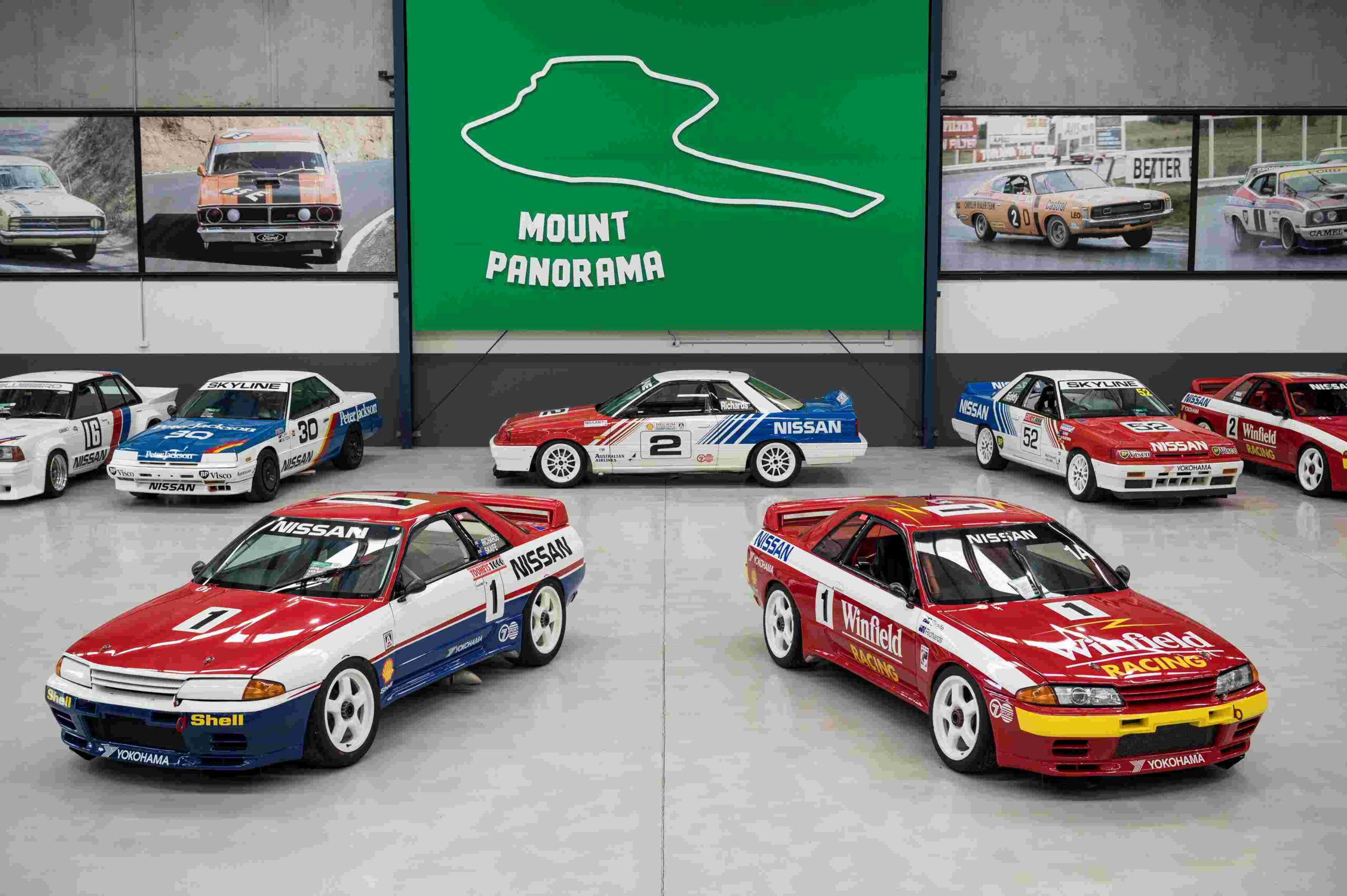
The dominance of the GT-R was so profound that in response to its prowess, a regulation change was swiftly introduced, effectively banning the Nissans from competing in 1993. It was an acknowledgment of their overwhelming success—a solution to quell the growing dissatisfaction among rival teams and fans.
Mount Panorama, with its rich history and dramatic backdrop, served as the crucible for the creation of an automotive icon. The GT-R’s victories were more than just dates in a record book; they signaled the emergence of a legend—one that would continue to haunt the competition long after it had left the track.
And so, amid the engines’ roars and the thunderous applause of adoring fans, the legend of Godzilla was cemented—a monster born on the unforgiving curves of Mount Panorama that would forever change the landscape of motorsport. In the years that followed, the GT-R not only dominated racetracks across Australia but also carved its name in the annals of automotive history, its legacy continuing to spawn admiration and envy in equal measure.
As we reflect on that rainy October day and the subsequent years of racing triumph, one thing remains clear: the Nissan GT-R is not just a vehicle; it is an enduring testament to the spirit of competition and the fierce will to conquer. The legend of Godzilla lives on, and it shows no signs of slowing down.