Volkswagen has unveiled yet another compact crossover to join its ever-expanding family—the Tera. Designed entirely in Brazil and making its flamboyant debut at the Rio de Janeiro Samba School Parade (because nothing says “practical family vehicle” like carnival dancers in elaborate costumes), this pint-sized SUV is set to become the most affordable offering in Volkswagen’s global SUV lineup.
The Little SUV with Big Ambitions
The Volkswagen Tera is essentially what happens when a Tiguan decides to downsize after watching too many tiny home renovation shows. With its sub-4-metre length (roughly 157.5 inches from bumper to bumper), this compact crossover manages to pack VW’s upscale design language into a city-friendly footprint.
“Honey, I shrunk the Tiguan!” could have been the design brief, as the Tera borrows styling cues from its larger siblings, the next-gen Tiguan and Taos facelift. The front end features a sleek honeycomb grille proudly displaying a large VW badge, flanked by LED headlights and broken-off LED DRLs that give it that distinctive “I’m squinting judgmentally at that parking space” look.
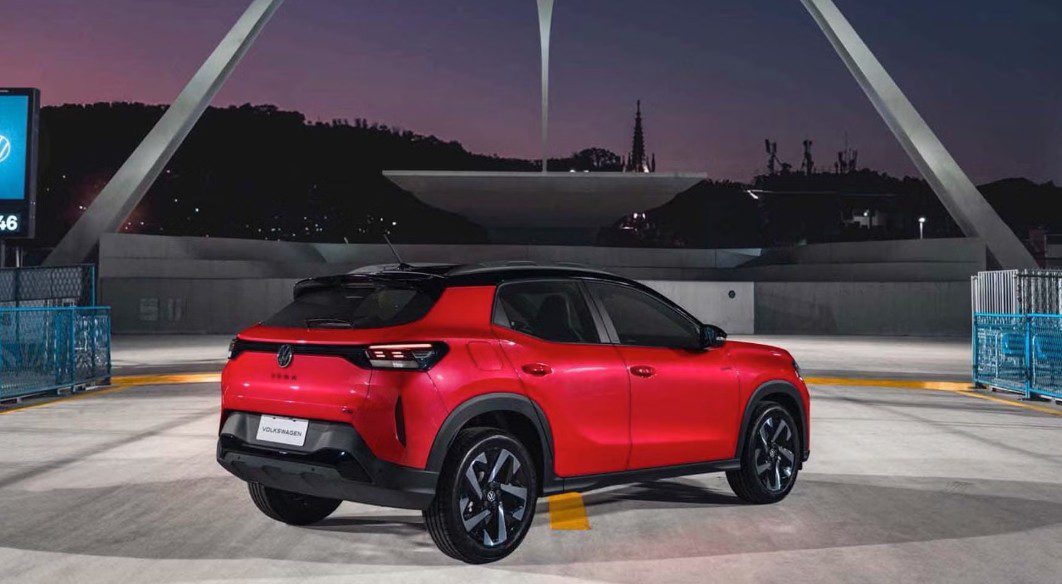
In profile, the Tera flaunts what VW’s marketing department would surely call a “dynamic silhouette,” complemented by 10-spoke diamond-cut alloy wheels and broad hips that suggest it does regular cardio. Around back, the LED taillights are connected by a black strip, with the “Tera” badge displayed proudly on the tailgate—also in black.
Under the Hood: Modest Power, Maximum Efficiency
While Volkswagen has been playing coy about the official engine specifications (perhaps building suspense for a reveal that will surely rival a Hollywood blockbuster), reports suggest the Tera will house a 1.0-litre TSi three-cylinder turbocharged petrol engine. This plucky little powerplant is expected to produce a respectable 116.38 HP and 178 Nm of torque—enough to get you to the organic farmers’ market before all the best artisanal kale is gone.
The Tera is built on Volkswagen’s MQB-A0 platform, which it shares with vehicles like the Polo, Nivus, T-Cross, and various Skoda models. For those unfamiliar with automotive platforms, think of it as the DNA that determines how a car behaves, minus the awkward family resemblance at reunions. Interestingly, unlike some platform-sharing exercises, the Tera doesn’t share any body panels with its cousin, the Skoda Kylaq, allowing it to maintain a distinct identity.
Transmission options will include both a 6-speed manual for driving purists who still enjoy rowing their own gears, and a 6-speed torque converter automatic for those who prefer their left foot to remain unemployed in traffic. And sorry, off-road enthusiasts—the Tera will be exclusively front-wheel drive, so those muddy trails will remain the domain of more rugged SUVs.
Interior: Simple, Yet Sophisticated
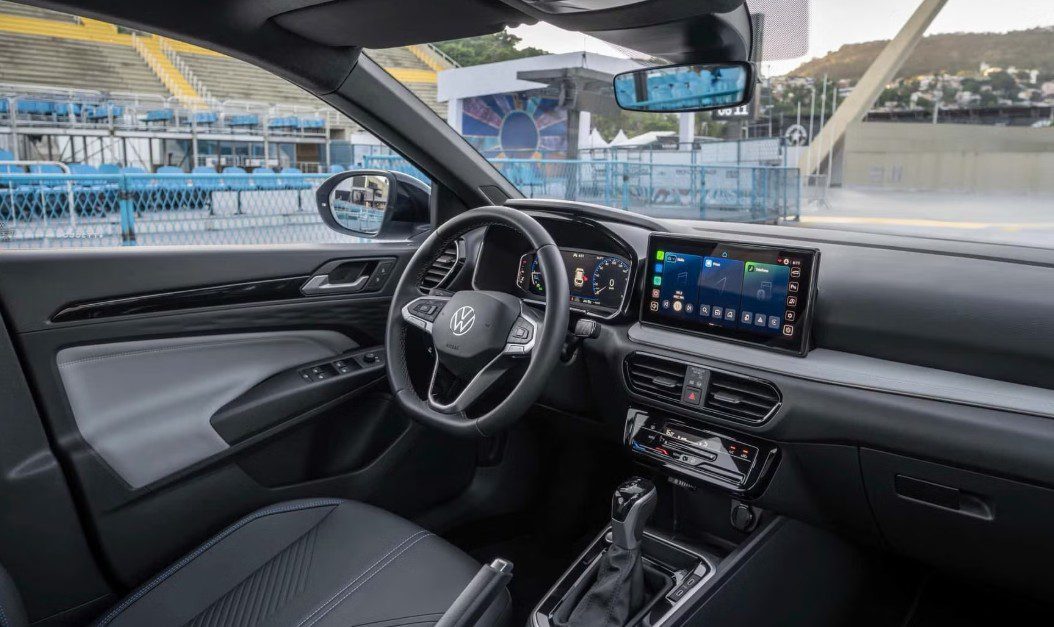
Step inside the Tera, and you’ll find an interior that Volkswagen has described as “simple”—though in VW’s vocabulary, that still means “nicer than your first apartment.” The cabin features a freestanding 10.25-inch touchscreen infotainment system that looks like someone glued an iPad to the dashboard (in the most elegant way possible).
Higher trim levels come with leather upholstery, ambient lighting, a digital instrument cluster, and the familiar three-spoke steering wheel that appears across Volkswagen’s lineup. Lower trims will likely offer cloth seating and fewer amenities, but all versions will include essential features like automatic climate control, a smartphone charging system, and the modern necessities that prevent today’s drivers from experiencing the character-building hardships of manual windows.
Tech-savvy drivers will appreciate the inclusion of ADAS (Advanced Driver Assistance Systems) features, which essentially allow the car to occasionally judge your driving decisions and intervene when necessary—much like having your mother-in-law in the passenger seat, but with less commentary.
Global Ambitions: From Brazil to (Maybe) Your Driveway
The Tera will first samba its way into Brazilian showrooms around May 2025, with production taking place at Volkswagen’s Taubate facility in Brazil (which also produces the Polo Track). While VW hasn’t announced global expansion plans for the Tera, industry watchers believe it’s only a matter of time before this compact crossover makes its way to other markets.
For the Indian market, the Tera is expected to arrive by early 2026, where it will square off against a formidable roster of competitors including the Tata Nexon, Maruti Suzuki Brezza, Hyundai Venue, Mahindra XUV 3XO, and Kia Sonet. Given Volkswagen’s positioning above Skoda in the Indian market, expect the Tera to be priced slightly higher than its cousin, the Skoda Kylaq, which currently sells between Rs 7.89 lakh and Rs 14.40 lakh.
American consumers, however, shouldn’t hold their breath for the Tera’s arrival. With import tariffs that would make this budget-friendly SUV considerably less friendly to budgets, Volkswagen will likely keep the Taos as its entry-level crossover in the US market, with prices starting at $24,995 for the 2025 model year.
Small Package, Big Potential
In a market saturated with compact SUVs, the Volkswagen Tera manages to stand out by being… well, another compact SUV, but with German engineering and Brazilian flair. It’s like showing up to a party where everyone is wearing black, but your black outfit has slightly better stitching and a hint of samba rhythm.
For budget-conscious consumers seeking Volkswagen quality in a smaller, more affordable package, the Tera represents an intriguing option. It offers the brand’s signature design language, decent technology, and presumably the solid driving dynamics VW is known for, all wrapped in a city-friendly package that won’t require you to take out a second mortgage.
Whether the Tera will become a global success story or remain a regional player depends on Volkswagen’s expansion strategy and how well it can differentiate this model in an increasingly crowded segment. One thing is certain—in the automotive equivalent of musical chairs, Volkswagen is making sure it has a seat at the compact SUV table, and the Tera might just be the chair it’s been looking for.
As the automotive world continues its inexorable shift toward crossovers and SUVs of every conceivable size, the Tera represents Volkswagen’s acknowledgment that sometimes, smaller is better—especially when it comes to parking spaces and fuel bills. Now we just need to wait and see if this samba-dancing SUV has the moves to win over global consumers.