Let’s all breathe a collective, slightly nervous, sigh of relief. For now, in the high-stakes, high-speed battle between human intuition and cold, hard artificial intelligence, flesh and blood still has the edge. But mate, the gap is closing, and it’s closing fast.
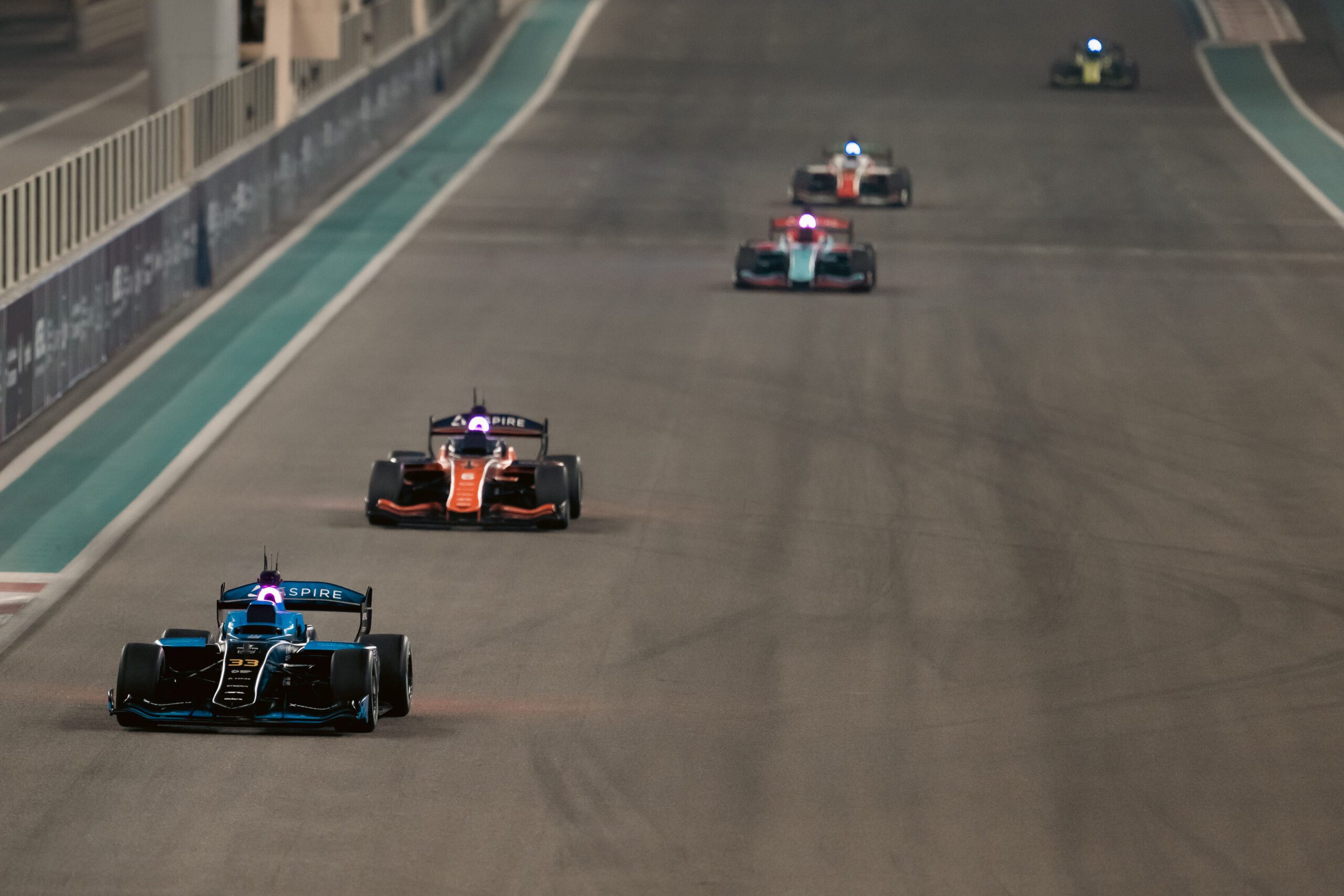
The scene was the Abu Dhabi Autonomous Racing League, A2RL, an event that sounds like a Star Wars droid designation but is actually the most electrifying proving ground for driverless tech on the planet. At the iconic Yas Marina Circuit, the main event wasn’t just a race; it was a world-first, six-car, fully autonomous Grand Final. Forget your science fair robotics club; this was a grid of AI-powered rockets battling for a $2.25 million prize pool, and it was absolute chaos in the best possible way.
The main race delivered drama that even the best F1 scriptwriters would be proud of. The German powerhouse, TUM, started on pole, looking dominant. But their glory was short-lived. The Italians from Unimore, clearly having fed their AI a breakfast of pure aggression, hunted them down and pulled off a stunning overtake for the lead before the end of the second lap. For the next ten laps, these two driverless machines duelled at speeds cresting 250 km/h, often with less than a second between them. It was a mesmerising, terrifying glimpse into the future of motorsport.

Then, the inevitable happened. In a moment of pure, unadulterated racing drama, the Unimore AI made a very… human mistake. While trying to lap a backmarker, it misjudged the move, clipped the other car, and sent them both spinning off the track. It was a ‘whoops’ moment of silicon-based miscalculation that handed the lead, and the championship crown, back to a patiently waiting TUM. The Unimore team principal, Marko Bertogna, was surprisingly philosophical, noting, “Even a human racing driver would not have been able to avoid the collision we had, so this is just the nature of high-performance racing”. TUM retained their title, but Unimore walked away with the fastest lap, a consolation prize for their sheer, raw pace.
But the real headline act, the one everyone was waiting for, was the ultimate grudge match: Man vs. Machine. In one corner, former Formula 1 star Daniil Kvyat, a driver known for his raw speed and aggressive style. In the other, “HAILEY,” the champion AI driver from team TUM, fresh from its main race victory.

The challenge was simple: Kvyat had ten laps to hunt down HAILEY, who was given a ten-second head start. The result was breathtaking. Kvyat, driving on the absolute limit, punched in a blistering best lap of 57.57 seconds. HAILEY’s response? A stunning 59.15 seconds.
That’s a gap of just 1.58 seconds!!!
Let that sink in. A seasoned F1 professional was only a second and a half faster than a car with nobody in it. As Kvyat himself admitted, the progress is “staggering”. Just 18 months ago, the gap in a similar showcase was a cavernous 10 seconds. The AI isn’t just learning; it’s learning at an exponential rate. The duo roared across the line in close succession, proving that while humanity won this battle, the war is far from over.

So, what’s the point of all this? Is it just a fantastically expensive remote-control car race? Not at all. As organisers state, A2RL is more than a race; it’s a “testbed accelerating the future of autonomous systems”. It’s “science in the public domain,” pushing the boundaries of what’s possible by subjecting the technology to the extreme pressure of competition. The CEO of ASPIRE, the group behind A2RL, noted that teams have achieved progress in just 18 months that would normally take years in a lab.
The AI that learns to calculate a perfect overtake at 250 km/h at Yas Marina is the ancestor of the AI that will one day safely navigate your family car through a messy Auckland intersection in the pouring rain. The teams have already unlocked capabilities that will influence far more than just racing, with AI-driven cars now capable of surpassing human benchmark lap times in qualifying sessions.
For today, we can give Daniil Kvyat a pat on the back and cheer for the human spirit. We held on. But with over 8,000 spectators watching on, the message from Abu Dhabi was clear: the machines are coming, and they’re getting faster with every lap. The question is, will be better than us?