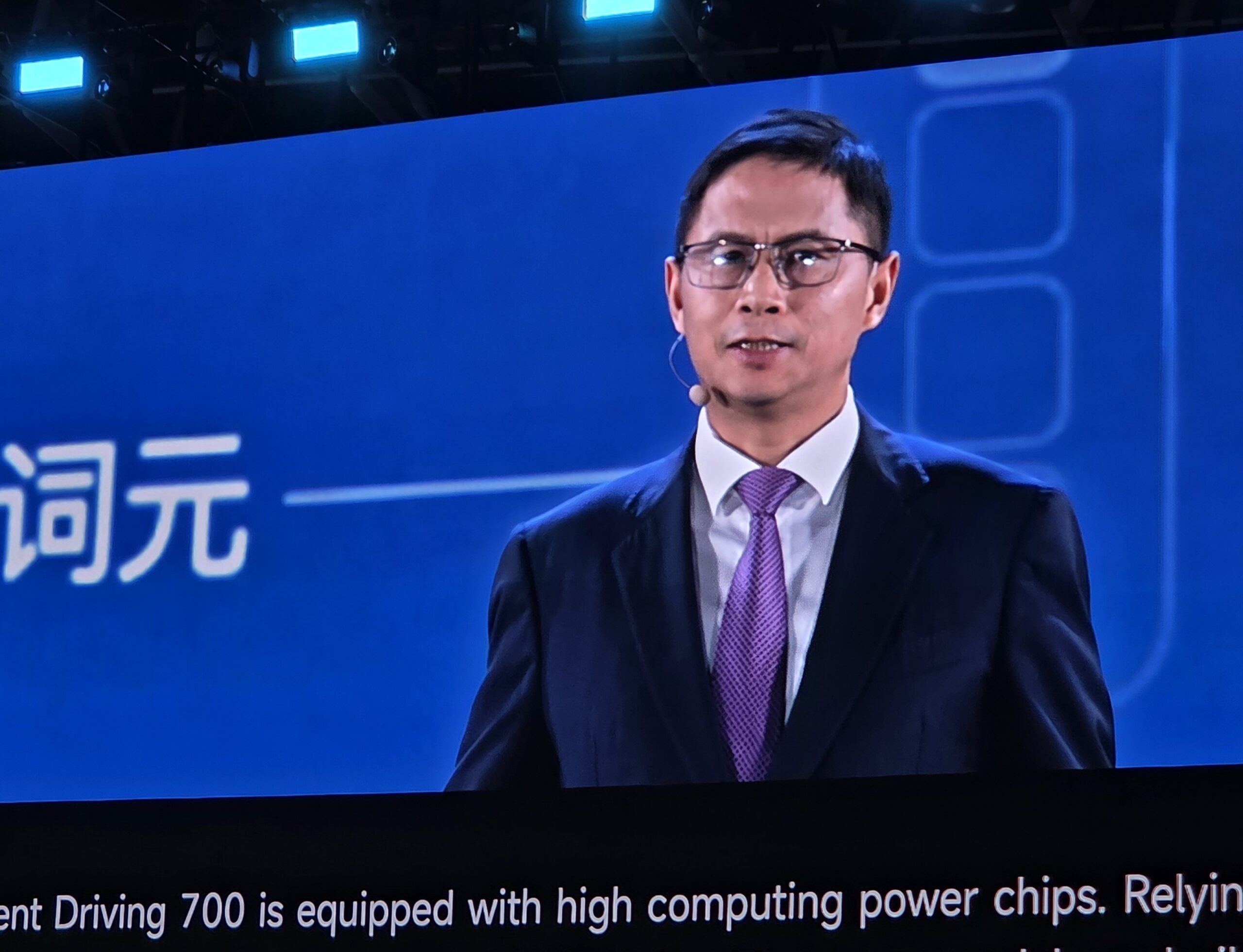
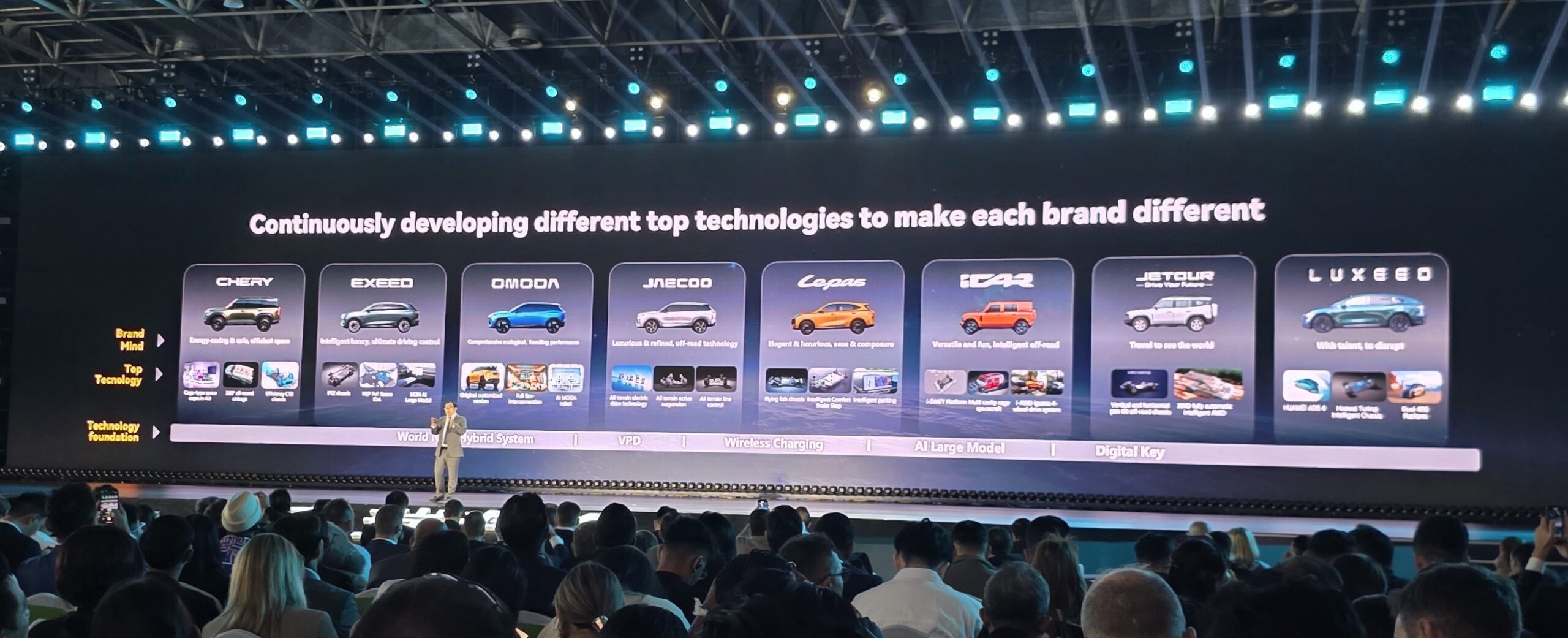
Speaking at their global innovation conference 2025 in Wuhu China, Chery’s Executive Vice President, Gao Xinhua, laid out a vision that goes far beyond just building better cars. The mission is to “transform from a traditional automaker into a global high-tech ecosystem group”.
Backed by a multi-billion-dollar blitz in global research, next-generation powertrains, proactive safety systems, and artificial intelligence that aims to do more than just drive, it aims to understand. Chery showed us how exactly how they intended to walk the talk.
The Global Brain – Thinking Globally, Engineering Locally
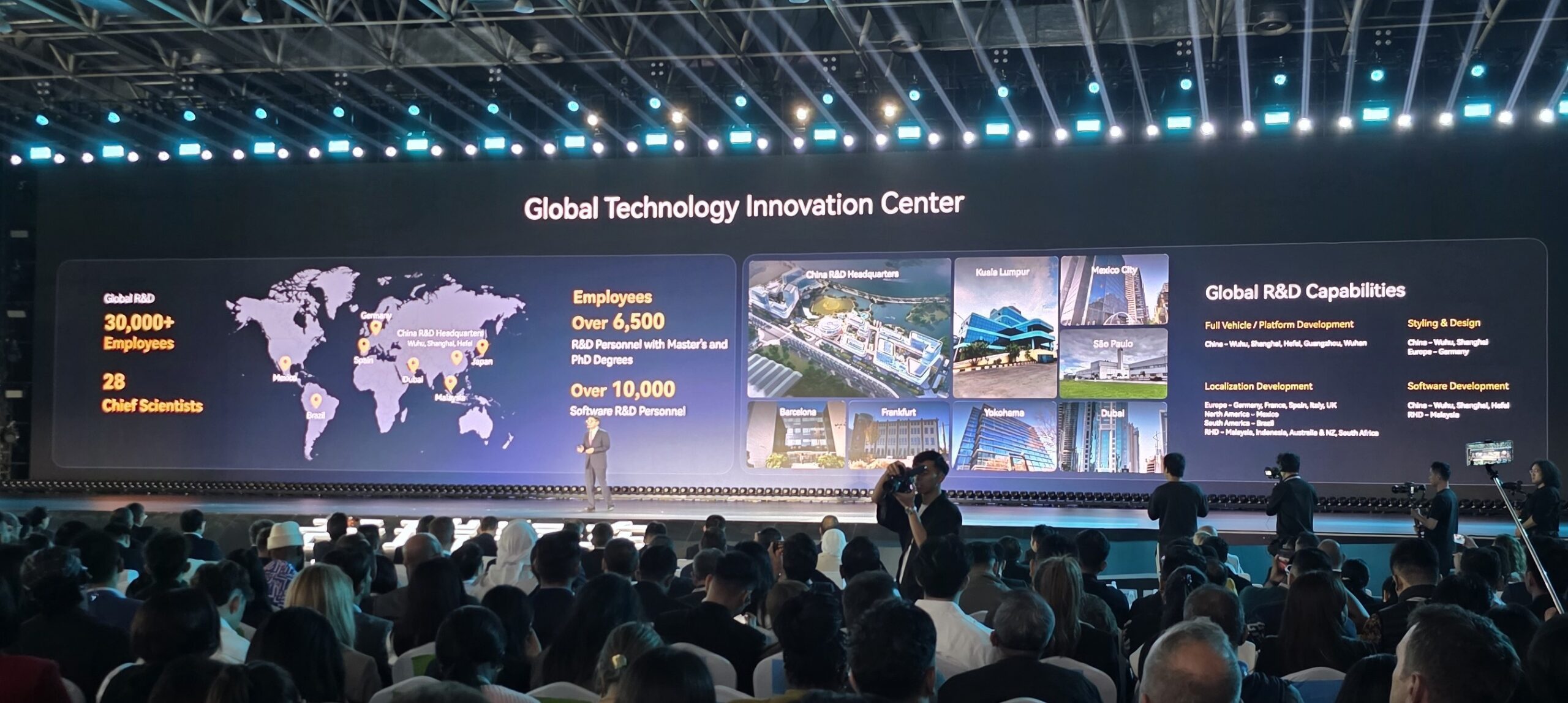
The cornerstone of Chery’s new era is a radical shift in its research and development philosophy, with a 1+7+N structure encapsulated by the mantra of moving “from internationalisation to globalisation strategy”. For many brands, ‘global’ means selling the same car everywhere with a few tweaks. For Chery, it means embedding its brainpower into the very markets it wants to serve.
The R&D headquarters in Wuhu China, is essentially the central nervous system. But branching out from this are seven major overseas research centres in strategic locations: Frankfurt, Barcelona, Yokohama, Dubai, Mexico City, and São Paulo. Gao Xinhua describes a philosophy of “In somewhere, For Somewhere, Be Somewhere,” a commitment to integrating local regulations, culture, climate, and geography to identify and serve “differentiated needs” – so think fuel and charging variations, language/voice, smart connectivity, digital radio and infrastructure.

What does this mean for the cars you and I might drive? It means a Chery developed with input from German engineers on the Autobahn, Spanish designers focusing on urban aesthetics, and Mexican teams testing for high-altitude performance. It’s a holistic approach designed to create vehicles that aren’t just sold globally but *belong* globally.
The confidence in this system is palpable. As Gao notes, “One of our European test engineers once told me that the cars that have passed our European test are superior to Western and German cars”. That’s a bold claim, but it’s backed by a network that has collaborated with top universities in over 60 countries, attracting thousands of talents to tackle over 4,000 technical projects. It’s about creating a global hive mind for automotive innovation.
The Heart of the Machine – A Powertrain Revolution 28 Years in the Making
While software and batteries dominate headlines, Chery hasn’t forgotten the soul of the car, the powertrain. With a history stretching back 28 years in independent powertrain R&D, their expertise is deep. The ACTECO engine brand, which debuted in 2005, has seen continuous evolution, culminating in some truly startling performance claims.

Gao Xinhua didn’t mince words when comparing their latest hybrid technology to rivals. “Could it be that you are driving a Lamborghini Huracan, well that V12 only has 470kW of power, while ours has 510kW. It only has 560Nm of torque, while ours has 750.” This isn’t just a numbers game; it’s a direct challenge to the established order.
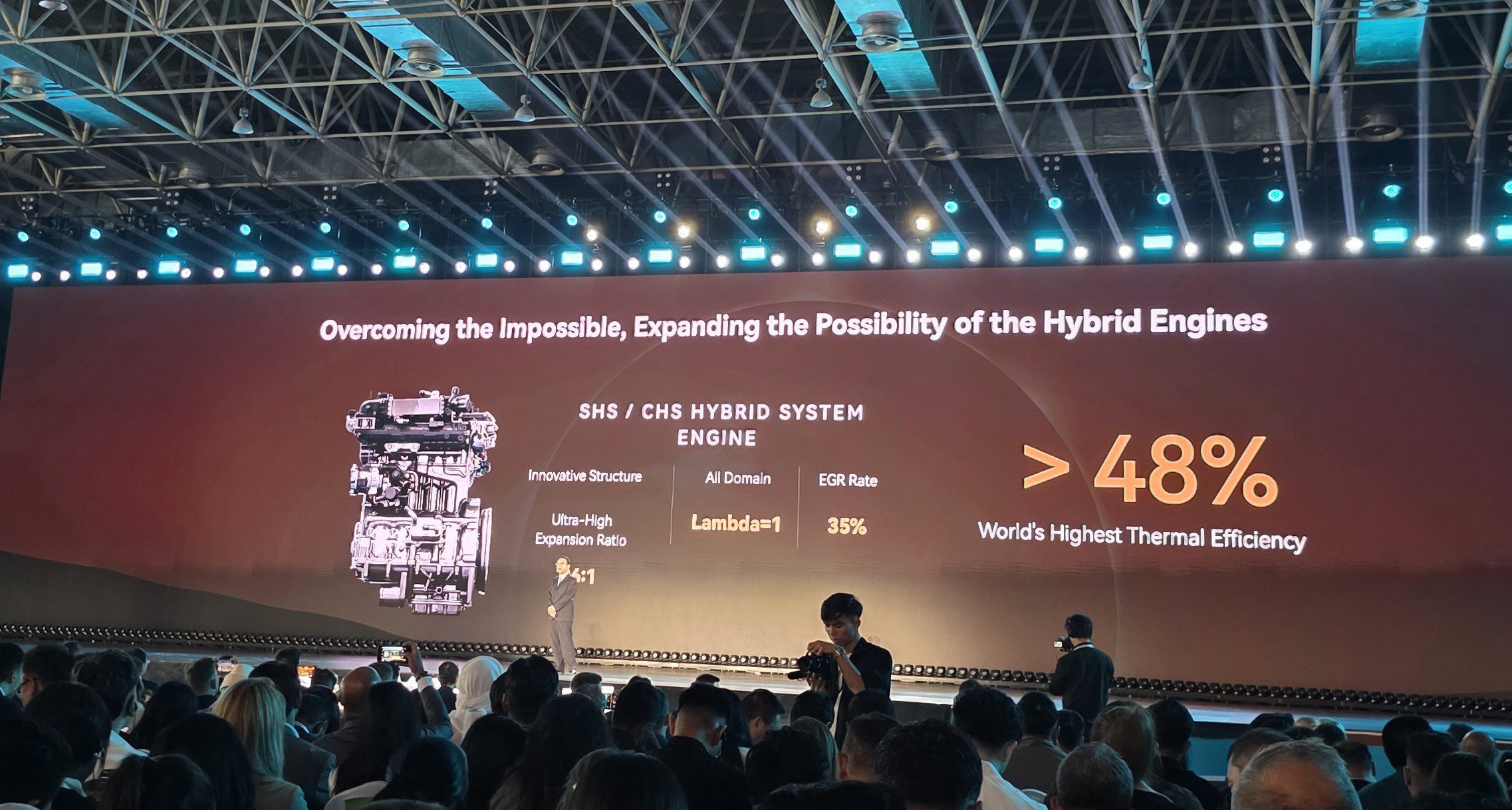
The secret sauce lies in groundbreaking engineering. Gao spoke of the “Kunpeng Tianqing engine,” a new engine structure that “perfectly combines the advantages of both cycles (Miller and Atkinson)” to achieve a daily thermal efficiency exceeding 48%, a figure he proudly labels a “global first”.
For the uninitiated, thermal efficiency is the holy grail of engine design. A higher percentage means more of the fuel’s energy is converted into motion, resulting in more power, better fuel economy, and lower emissions. To achieve nearly 50% in a mass-market application is a monumental achievement, one that Gao notes fills his team with immense pride, representing a leap forward not just for Chery, but also Chinese brands as a whole.
The Electric Soul – Charging into the Future
Chery’s new energy strategy isn’t a recent development; it was officially announced back in 2003, with a focus on hybrid and full-electric vehicles from the outset. Today, that long-term vision is materialising in the form of highly advanced battery technology.
The specifications are impressive. Their series of batteries boasts a 5,000-cycle lifespan, while another boasts an energy density of 310 watt-hours per kilogram. High energy density is crucial, as it allows for longer range without the penalty of excessive weight, improving both efficiency and vehicle dynamics.
But as with everything else, the focus returns to safety and reliability. Chery has designed brutal test protocols that go beyond standard requirements, such as one that combines “extrusion and water intrusion”. Even when subjected to 50% extrusion and then submerged in water, the battery pack continued to function normally without leakage. This is the kind of engineering that builds deep consumer trust. The cells have also been dropped, bashed and drilled through to prove there is no chance of fire and a thermal runaway.
Looking forward, the company has already established a “solid-state electronics R&D platform,” showing they are not just competing in today’s battery race, but are already preparing for the next generation.
The Guardian Angel – Engineering a Proactive Safety Bubble
In an era of increasing vehicle autonomy and complexity, safety has taken on a new dimension. Chery’s approach is to move beyond passive reactions and into the realm of proactive prediction and protection. They are redefining safety systems with technology and have established a Global Safety Research and Analysis Centre to drive development using data from real-world incidents.
This data-driven philosophy is breeding genuine innovation. Take airbags, for instance. By analyzing their library of thousands of real-world collision scenarios, Chery has developed unique solutions like rear windscreen airbags to protect third-row passengers in rear-end collisions. It’s a level of specific, thoughtful design that demonstrates a deep commitment to occupant safety in all seats.

Furthermore, Chery is merging safety and intelligence. Gao’s speech detailed how intelligent perception from the autonomous driving system is combined with safety robotics. In a scenario like an impending rear-end collision with a large truck (where a typical car’s sensors might struggle) the Chery system can use its advanced perception to make a more accurate and life-saving maneuver.
The results speak for themselves. The company has received a staggering “54 five-star safety ratings” globally, proudly claiming the title of “the Chinese brand with the most five-star ratings worldwide”. But for Chery, even this isn’t the finish line. “We believe that testing isn’t enough,” Gao states, explaining their goal is to conduct global challenges that “far exceed standards” to ensure users receive exceptional five-star security even in the most extreme circumstances.
This obsession extends to “invisible” safety, with a focus on information security, protecting against hacking, and even occupant health, with innovations like patented plant-based hypoallergenic materials and batteries with radiation levels at a mere 2% of the national standard.
The Digital Co-Pilot: AI That Proactively Understands
The final, and perhaps most futuristic, piece of Chery’s technological puzzle is its approach to artificial intelligence. Gao Xinhua calls AI “the core engine for intelligent driving to move towards autonomous travel”. Chery’s strategy is to create a system that doesn’t just see the world but comprehends it.
This is enabled by a massive data and computing infrastructure. The company has deployed “4,000 events globally with partners” and leverages ultra-large-scale computing power to train its “learning world models”. This raw power fuels an end-to-end driving system designed for smoother, more accurate control from sensor to steering input.
The true leap, however, is the ambition to upgrade the autonomous system from “mechanical recognition to proactive understanding”. Using advanced cameras and algorithms, the system can identify and comprehend textual content on road signs or understand the nuanced context of a temporary construction site. This is the difference between a car that simply stays in its lane and a car that is a true co-pilot, aware and responsive to the complexities of the real world. It’s getting smarter, and better at understanding you.

The Road Ahead – includes water
Chery’s transformation is a multifaceted, deeply funded, and strategically brilliant campaign to ascend to the top tier of the automotive world. The “Qinling Mars TDC architecture” serves as the foundation for this global product development, a powerful fusion of hardware and intelligent control.
Then there’s Chery’s Ark Amphibious technology, a significant innovation that resulted from five years of research, blending fluid dynamics with marine technology to allow a vehicle to operate across water. This system utilises a high-pressure propulsion system with specialised propellers, triple-layer sealing to achieve an IP68 waterproof rating for up to 120 minutes, and a design that ensures stability in water, all intended to provide a new level of safety and user experience – yes your Chery car, can be a boat too (not recommended in your current Tiggo 4 though – this will be a specific model)
From world-first engine efficiencies and hyper-local R&D to proactive AI safety systems and next-generation batteries, every component of the vehicle is being reimagined.
Tarmac Takeaway
This is the story of a global technology company setting new benchmarks. Chery is building a technologically advanced new wing onto the entire industry,while keeping a keen eye on safety and sustainability. The only question left is how quickly the rest of the automotive world will have to adapt to keep up.