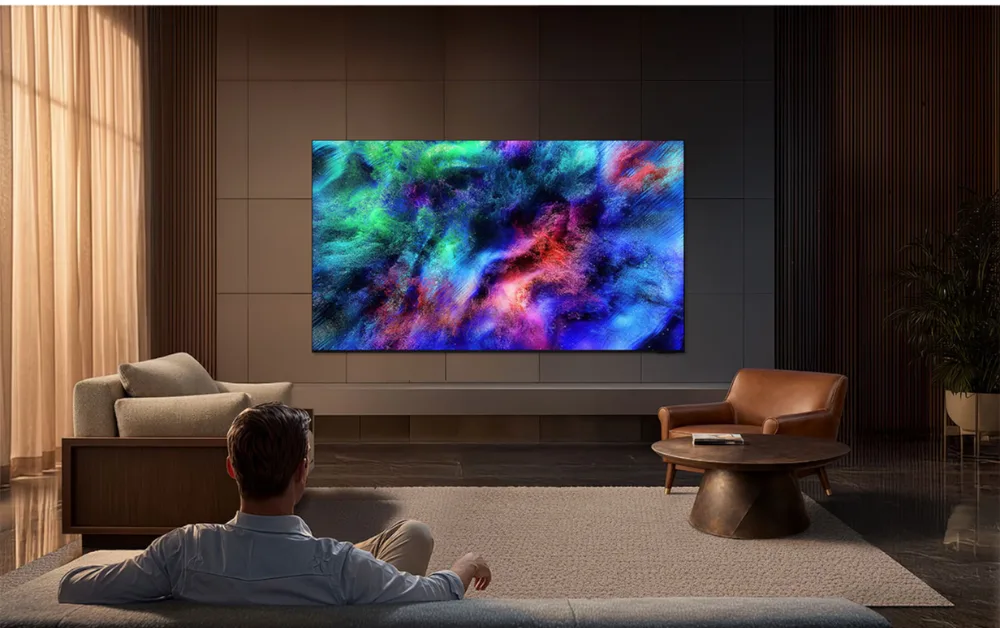
There is a particular kind of quiet that happens in a lounge when a new television is actually good. Nobody comments on the picture. Nobody fiddles with settings. The dog does not get shooed off the good couch to make room for a demo. People just watch. That is the test I set for the Samsung R95H Micro RGB TV over the fortnight I had it in for review, and it is the test that matters far more than any spec sheet.
I first laid eyes on this thing at Samsung’s Australian launch event earlier this year, and I will admit to a bit of scepticism. Micro RGB is new technology, and new technology in TVs usually means a first-generation compromise somewhere. Two weeks of actual family viewing later, on my own couch rather than a stage in Sydney, I cannot find that compromise. This is a genuinely excellent television, and I’ll try to explain why in the way I would to a mate rather than in the way a lab report would.
Micro-RG-what-now?
The short version, without the tech-nerd stat dump: most LCD televisions make colour by shining a white or blue backlight through a layer of colour filters. Samsung’s Micro RGB panel instead uses thousands of individual red, green and blue LEDs to produce colour directly, which is why Samsung can claim full coverage of the wide BT.2020 colour space, a claim that has been independently VDE certified. In the lounge, what that means is colour that looks correct rather than colour that looks punched up. Skin tones on the Jamie Oliver cooking programme I tested it with looked like skin, not like a filter. A dark, moody thriller scene held onto shadow detail instead of crushing into a grey mess, helped by the panel’s local dimming, which controls brightness across more than 1,300 individual zones on the 65-inch model.
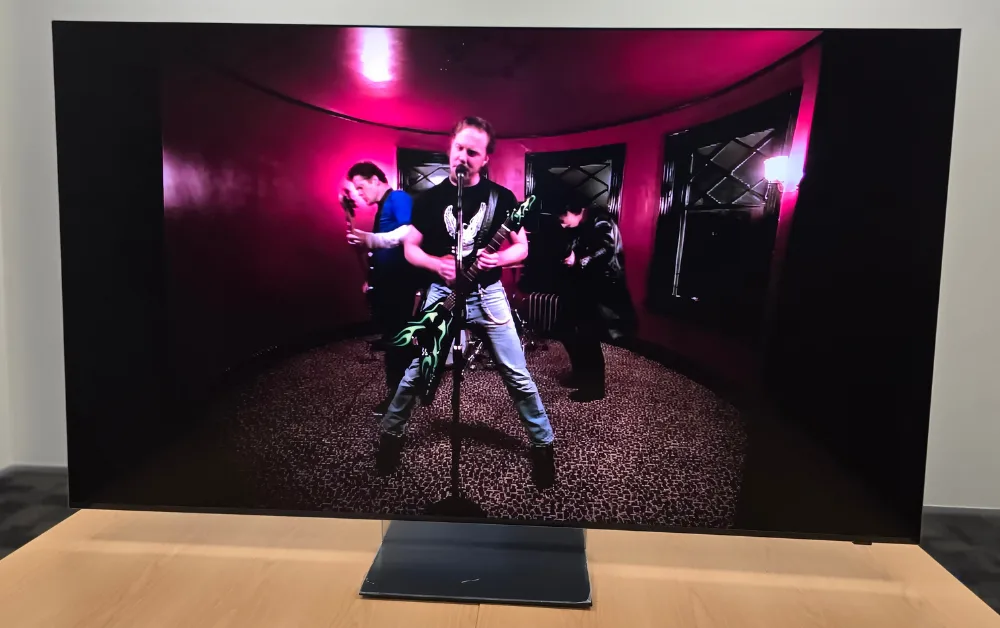
Brightness is the other half of the story, and this set has plenty of it, with independent testing putting peak brightness above 2,300 nits on the 65-inch model. That matters less for cinema-dark viewing and much more for the next section, which is the one that matters most to me as someone who does not live in a blacked-out home theatre.
I am not the only one who has come away impressed. A friend with a much more detailed eye than mine came over and called the R95H more impressive than any television he had seen since his first OLED. Independent tests around the world have measured the widest colour range of any TV tested to date, wider than premium OLED rivals included. When trawling through other folks’ experiences, people who test TVs for a living reach for comparisons like that, the leap here is clearly real rather than a figment of my imagination.
Built for a room with actual windows in it
Every review of a Samsung 2026 TV I have written this year has come back to the same point, and it is worth repeating here because it is the single biggest quality-of-life upgrade in this set. Samsung’s Glare Free coating, UL certified and now extended down into the Micro RGB range for 2026, actually works. It scatters incoming light rather than mirroring it straight back at you, so the afternoon sun through my windows did not turn the screen into a black mirror the way it would on most glossy panels. I did not have to close the curtains or angle the couch to keep watching. For a New Zealand lounge, where curtains are more often open than shut, this is not a nice-to-have feature. It is the feature that decides whether you enjoy the television during daylight hours at all.
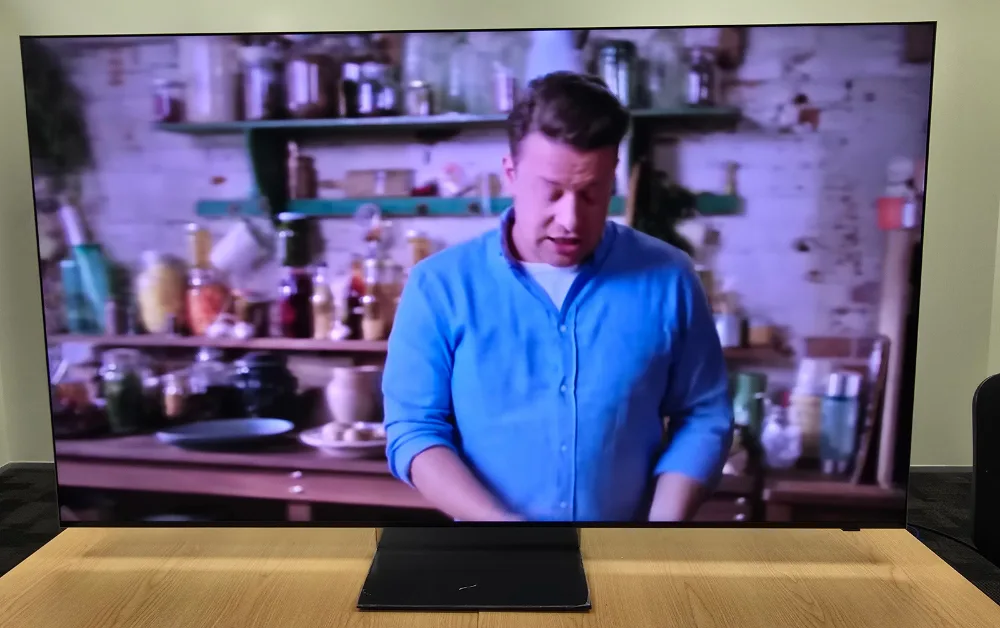
The panel also carries a matte finish that helps here, and the two together mean this is the first TV I have tested this year that looked as good at three in the afternoon as it did after dark.
We also ran this in my office with a whole-wall window and bright ceiling lights in play and we had to work pretty hard to find a reflection on this screen. All my own photos herein were taken in the office with all those lights everywhere. Good luck finding them reflected on the panel!
Living with it day to day
Let’s keep this practical. Getting the R95H out of the box and onto its stand took less time than boiling the jug. The stand now simply clips into place with no screws required, and the whole panel is noticeably lighter to lift than an equivalent-sized Samsung TV would have been only a couple of years ago. If you are upgrading from an older Samsung set, the SmartThings phone app will pull most of your existing settings, logins and preferences across automatically, which quietly removes one of the most annoying chores of moving day.
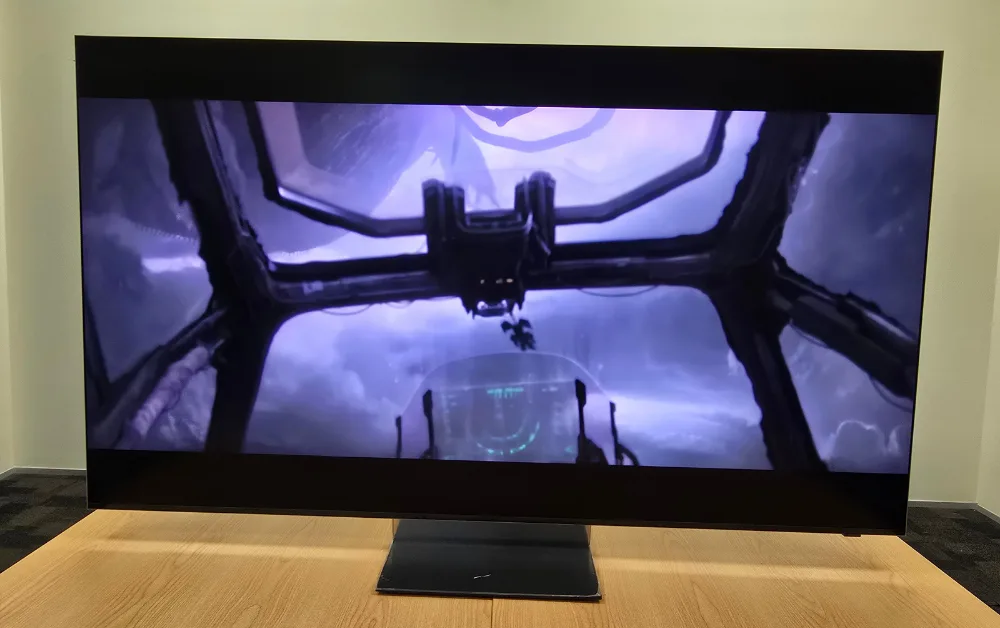
Tizen’s smart interface is fast, and the apps I open every day loaded without the stutter I remember from TVs even a couple of years old. Samsung’s commitment to seven years of software updates on this model is the kind of detail that should make anyone nervous about buying a smart TV relax a little. You are not buying a device that will feel abandoned in eighteen months. I was also glad to find a genuinely quick way to override whichever picture mode Samsung’s AI decides you should be watching in, since that usually means hunting through sub-menu after sub-menu on other brands’ TVs. Here, one press of the remote drops a small menu into the corner of the screen showing four sample pictures to choose between, so you pick the one that looks right rather than guessing at sliders.
For the gamers in the house, the R95H is seriously quick on the numbers that matter. It has four HDMI 2.1 ports at the full 48Gbps, support for up to 165Hz at 4K resolution and independently measured input lag low enough that fast-paced games should feel properly responsive rather than laggy. Samsung’s Gaming Hub also bundles Xbox Game Pass, GeForce Now and Amazon Luna straight into the TV, so someone can be playing within a minute of picking up a controller with no console plugged in at all. If your cabling situation is a mess behind the telly, Samsung also sells an optional wireless One Connect box that moves the HDMI ports into a separate unit near your gear, which is a sensible bit of engineering for anyone who has ever tried to hide a rat’s nest of cables behind a wall-mounted screen. If you want to focus on sport, you’ll find the same fast, clean motion with a rugby ball or cricket bat in frame, useful if weekend sport is non-negotiable in your house.
None of the AI features Samsung talks up on stage (the sports mode, the voice-isolating tricks, the on-screen companion) changed my day-to-day viewing in any way I noticed. They are there, they do no harm and they are not why you buy this television. You buy it for the picture.
The Music Studio 7: more speaker than I expected
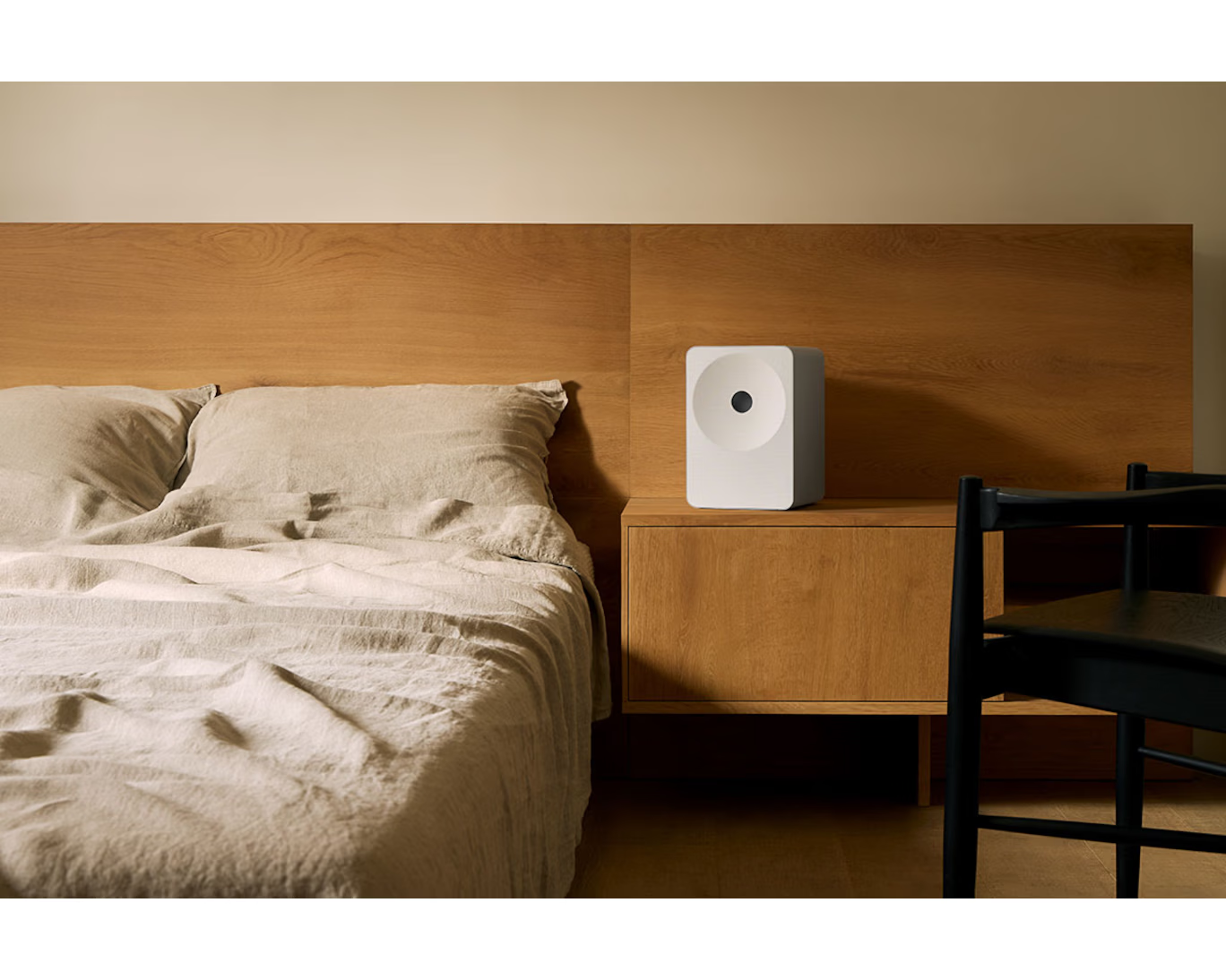
Alongside the R95H, Samsung sent through the Music Studio 7, its 2026 flagship wireless speaker, and it turned out to be the biggest surprise of the two weeks. Designed by Erwan Bouroullec around a deliberately sculptural moon-and-dot shape rather than the usual black rectangle, it does not look like audio equipment so much as an ornament that happens to sound extraordinary. Behind the metal mesh front sits a genuine 3.1.1-channel system, five drivers including a dedicated woofer and an up-firing channel, all from a single unit small enough to sit on a sideboard.
The R95H and Music Studio 7 pair through Q-Symphony, letting the TV’s own speakers and the Music Studio 7 work together rather than one switching off in favour of the other, which is super cool. Samsung says up to five compatible sound devices can be linked to a single TV this way, with the system’s own room calibration handling the tuning.
I did not expect much from one box pretending to be a surround system. I was wrong. With Dolby Atmos content it throws sound believably wide and gives it real height, and while it does not match the immersion of the proper 5.1 setup with a wireless subwoofer I run at home, it gets closer than a speaker this size has any right to get. For a family that wants dramatically better sound than a TV’s built-in speakers without running cable through the walls for a full surround system, this is a compelling single-box answer, and the R95H’s own built-in 4.2.2-channel, 70-watt array with Dolby Atmos and Object Tracking Sound+ is already a solid step up from typical flat-panel audio on its own.
The verdict
I have checked out a lot of televisions this year, and very few of them have made me stop thinking about the television at all, which is the highest compliment I can pay one. The Samsung R95H does exactly that. It handles a bright Kiwi lounge better than anything else I have had a look at, it renders colour honestly rather than garishly, it is quick enough for serious gaming and it is backed by a company that is not going anywhere. Paired with the Music Studio 7, you get genuinely cinematic sound without an afternoon spent running speaker cable.
If you are weighing up whether this is a safe, sensible upgrade for a family lounge rather than a gadget-lover’s indulgence, I can tell you plainly that it is the former. This is an easy recommendation.
Now you’ve read this, go get the actual information on the TV from Samsung:
www.samsung.com/nz/tvs/micro-rgb/r95h-65-inch-4k-smart-tv-mra65r95hasxnz
Samsung supplied the R95H and Music Studio 7 for the purposes of this review. No payment was made or received for this article, and both units were returned to Samsung once testing was complete.